
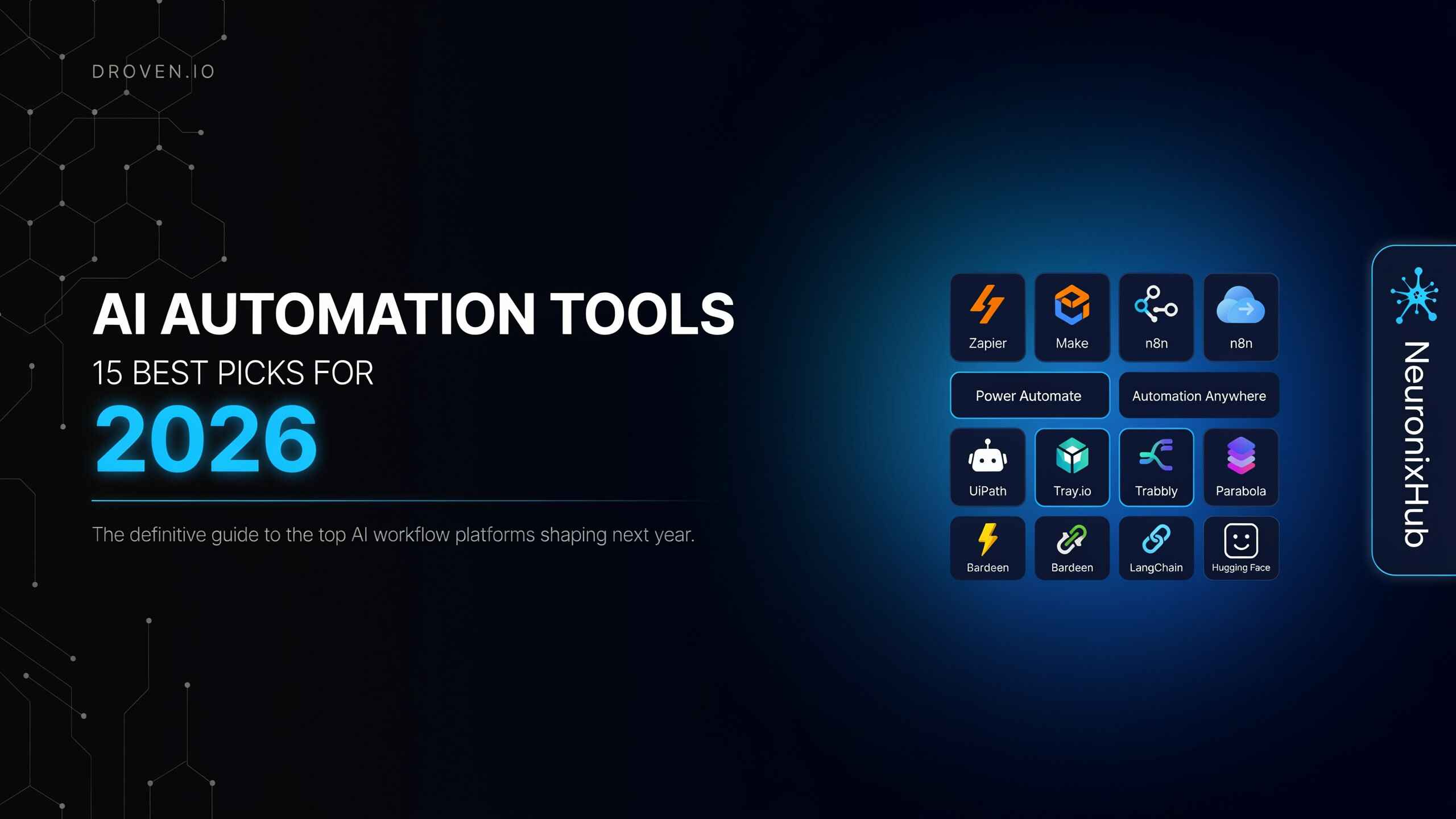
You probably landed here after typing “droven io ai automation tools” into Google, hoping for a straight answer: which tools actually work, and which ones are worth your time in 2026. Fair question. New automation platforms launch almost weekly, each promising to save you hours and cut costs. Sorting genuine value from marketing noise takes real research — research most business owners don’t have time for.
That’s the gap this guide fills. Below are 15 AI automation tools shaping how businesses handle everything from lead capture to customer support in 2026 — the same tools that keep coming up in serious conversations about workflow automation. Before the list itself, it helps to understand what Droven.io actually is, and why it’s become a reference point for people making these decisions.
What Is Droven io and Why It’s Gaining Traction in 2026
A Quick Overview of the Droven io Platform
Droven.io isn’t software you install or a dashboard you log into. It’s an independent knowledge platform that researches and explains AI automation tools in plain language, without the sales pitch. Rather than pushing one product, it breaks down entire categories — workflow platforms, RPA systems, conversational AI, machine learning infrastructure — so readers understand what a tool actually does before spending a dollar on it.
Who Should Be Using AI Automation Tools Like Droven io
This makes Droven.io especially useful for founders, operators, and non-technical decision-makers who know automation matters but feel buried in vendor noise. If you’re comparing options, unsure where to start, or tired of demos that oversell, it offers something rarer in this space: a neutral starting point before you commit budget to any tool.
How We Evaluated the Best AI Automation Tools
Key Criteria: Ease of Use, Integrations, Pricing, and Scalability
Not every automation tool deserves a spot on a “best of” list, so we applied a consistent filter. Ease of use: can a non-technical team member build a workflow without weeks of onboarding? Integrations: does it connect cleanly with the apps you already run — CRMs, email platforms, ecommerce systems? Pricing: is the cost structure predictable, or does it punish you as usage grows? Scalability: can it handle a five-person startup today and a two-hundred-person company next year, without a painful migration?
Why Automation Matters More Than Ever in 2026
Automation isn’t optional anymore. Rising labor costs, customers who expect instant responses, and growing operational complexity mean businesses that skip automation fall behind the ones that don’t.
The 15 Best Droven io AI Automation Tools for 2026
These are 15 tools that consistently show up in serious conversations about AI automation in 2026 — no-code workflow builders, enterprise RPA platforms, AI agent frameworks, and conversational AI systems. We haven’t ranked them “best overall,” because that framing rarely helps anyone. Each entry covers what the tool does, its standout features, a general sense of pricing, and who it’s actually built for, so you can match capability to your situation instead of chasing whatever’s trending.
Some of these are five-minute setups. Others demand real technical investment but unlock far more control. Read with your own team’s technical comfort and budget in mind. First up — the tool most beginners reach for: n8n.
1. n8n — Best for Self-Hosted, Developer-Friendly Workflow Automation
n8n is an open-source workflow automation platform that gives technical teams full control over how their automations run. Unlike fully cloud-locked competitors, it can be self-hosted — which matters a lot for businesses handling sensitive customer data, financial records, or anything with compliance requirements. It connects to hundreds of apps and APIs, but its real strength is flexibility: developers can drop custom JavaScript directly into workflows when a pre-built integration doesn’t quite fit.
Self-hosting is free beyond your own server costs; the cloud version runs on a more predictable execution-based model than some competitors. The tradeoff is a steeper learning curve than pure no-code tools. But for businesses with even one developer on staff who want deep customization without vendor lock-in, n8n is one of the most capable platforms available in 2026.
2. Make (formerly Integromat) — Best for Visual, Complex Multi-Step Workflows
Make’s visual, drag-and-drop builder lets you see your automation as a flowchart, with data moving between apps in real time — far easier to debug than tools that hide logic behind lists and menus. If you need a process with multiple conditional paths — routing leads differently based on source, budget, and location, all at once — Make handles that complexity better than most competitors.
It connects with over a thousand apps and supports custom API calls for anything not natively covered. Pricing is operation-based rather than per-task, which can suit workflows with many small steps. It’s a strong middle ground between Zapier’s simplicity and serious automation depth — a good fit for marketing and ops teams running intricate, multi-branch processes.
3. Zapier AI — Best for Beginners and No-Code App Integrations
Zapier AI is where most people take their first real step into automation. It connects over 6,000 apps through triggers and actions called “Zaps” — a new form submission can automatically land in your CRM, trigger a Slack notification, and send a follow-up email, no code required. Its AI features now let you describe a workflow in plain English and have Zapier build it for you.
The interface is genuinely beginner-friendly, which is why so many small businesses start here. The catch is pricing: Zapier bills per task, not per workflow, so a ten-step Zap firing a thousand times a month burns through your plan fast. Calculate expected volume before committing. Still, for a first attempt at automation, or a team without technical resources, Zapier remains the lowest-friction entry point in 2026.
4. GoHighLevel — Best for Marketing Agencies and Lead Gen + CRM Automation
GoHighLevel bundles CRM, email and SMS marketing, funnel building, appointment scheduling, and lead automation into one platform, instead of connecting separate apps together. That’s especially popular with agencies managing multiple clients, who can white-label the whole system and run it under their own brand rather than stitching together five subscriptions.
Its strength shows in lead nurturing: when a prospect fills out a form, GoHighLevel can tag them, trigger a text, schedule a follow-up call, and move them through a pipeline — all from one dashboard. The “all-in-one” design is also its main limit. Need deep customization or an obscure integration? It can feel restrictive. But for agencies and small businesses wanting lead gen, CRM, and automation without juggling logins, it’s a strong, purpose-built choice.
5. UiPath — Best for Enterprise-Grade Robotic Process Automation (RPA)
UiPath operates on a different scale. It’s built for enterprises processing thousands of repetitive transactions daily — invoice processing, compliance checks, data entry across legacy systems without modern APIs. It traditionally relied on “screen scraping,” where bots mimic human clicks inside old software. By 2026 it’s expanded well past that, adding intelligent document processing, process mining to flag which workflows are worth automating, and AI-driven decision-making layered on top of its bots.
This isn’t a small-team tool. Implementation typically needs dedicated technical staff and real budget, usually justified only when automating high-volume, error-prone back-office work. But for large organizations drowning in paperwork or juggling outdated systems that must talk to each other, UiPath remains one of the most battle-tested RPA platforms available, particularly in finance, healthcare, and insurance.
6. Microsoft Power Automate — Best for Microsoft 365 and Enterprise Ecosystem Integration
For businesses already running Microsoft 365, Power Automate is the path of least resistance. It’s built into the Microsoft ecosystem — Outlook, SharePoint, Teams, Excel, Dynamics 365 — without the third-party workarounds other tools sometimes need. A new file in SharePoint can trigger a Teams notification, update an Excel tracker, and send an approval request in Outlook, all from templates.
Its AI capabilities have grown fast: AI Builder lets you add document processing, sentiment analysis, and prediction models straight into workflows without separate ML expertise. Pricing usually bundles into existing Microsoft 365 or Azure subscriptions, simplifying budgeting. The tradeoff is flexibility outside the Microsoft world. But for organizations standardized on Microsoft infrastructure, it’s a natural, low-friction automation layer.
7. Pipedream — Best for Developers Who Want Code-Level Workflow Control
Pipedream sits closer to the developer end of the spectrum. Automation shouldn’t force a choice between no-code simplicity and real programming power, so every step can be a pre-built action or a custom code block in Node.js, Python, Go, or Bash. Wire together an integration visually in minutes, then drop in code exactly where the built-in actions fall short.
It connects with thousands of APIs and handles webhook creation, event triggers, and scheduled jobs with minimal setup. Pricing is usage-based, tied to compute time and executions — favoring lean, efficient builds. It’s not built for non-technical teams; there’s a real learning curve if you’ve never touched code. But for developers who find visual-only tools limiting, it’s a rare middle ground between control and fast iteration.
8. Activepieces — Best for Open-Source, Self-Hosted Automation on a Budget
Activepieces offers the flexibility of a self-hosted tool like n8n with a gentler learning curve. It’s fully open-source, so businesses can host it on their own servers at essentially zero licensing cost — a real advantage for startups and budget-conscious teams that still want data privacy and control. The interface leans no-code, using a piece-based system where each “piece” represents an app or action, making workflows easy to read even for non-developers.
Its growing library of AI-specific pieces lets teams plug in language models for summarization, classification, or content generation directly inside a workflow, no custom coding needed. Community-built integrations expand quickly, though the ecosystem is still smaller than Zapier’s or Make’s. For startups, nonprofits, or lean teams that want self-hosted control without a steep barrier, Activepieces delivers real capability without an enterprise price tag.
9. Lindy — Best for AI Agent-Based Task Automation and Delegation
Lindy takes a different approach from the connector-style tools above. Instead of rigid, step-by-step workflows, you create AI “agents” you delegate ongoing tasks to — almost like hiring a digital assistant. One agent might monitor your inbox and draft replies to common questions; another might qualify inbound leads by researching a company before a sales call, then summarizing what it found.
Setup happens mostly through natural language — describe what you want the agent to do, and Lindy builds the logic, pulling in calendars, email, and CRMs as needed. That makes it far more approachable than agent frameworks requiring actual code. The tradeoff is less granular control than a custom LangChain build. For teams wanting AI that handles judgment calls, not just data transfers, Lindy is a genuine step up from traditional automation.
10. Gumloop — Best for No-Code AI Workflow Building for Non-Technical Teams
Gumloop is built specifically for AI-heavy workflows, rather than bolting AI onto a general automation tool. On a drag-and-drop canvas, teams can chain steps like extracting data from a PDF, summarizing it with an AI model, checking it against a spreadsheet, and posting the result to Slack — no code, no need to understand the models underneath.
It shines on document-heavy and research-heavy processes: parsing contracts, scraping web data, generating reports from scattered sources. Non-technical teams pick it up fast because each step is visual and clearly labeled. It supports multiple AI models, so you’re not locked into one provider’s pricing or capabilities. The tradeoff is a narrower focus on AI-driven tasks than broader app-to-app automation — it works best alongside a general workflow tool, not instead of one.
11. Relevance AI — Best for Building and Deploying Custom AI Agent Teams
Relevance AI goes a step beyond single-agent tools like Lindy, letting businesses build entire teams of AI agents that work together on multi-part processes. Instead of one assistant handling a task end-to-end, a research agent might gather company data, a writing agent drafts outreach based on those findings, and a reviewing agent checks tone and accuracy before anything sends — each agent handling its own piece.
This “agent team” structure suits genuinely complex workflows that don’t fit a single automation — sales research, content pipelines, support triage requiring multiple layers of judgment. The no-code interface for configuring agent behavior means building multi-agent systems doesn’t require an ML background. It’s more sophisticated, and admittedly harder to plan properly, than most tools here. But for teams ready to move past single-task automation, Relevance AI offers a real glimpse of where workflow orchestration is heading.
12. Bardeen — Best for Browser-Based Automation and Web Scraping Tasks
Bardeen lives directly inside your browser rather than as a separate platform, which makes it useful for tasks that happen on websites your team already visits daily. It can pull data from a LinkedIn profile, a job listing, or a competitor’s pricing page and send it straight into a spreadsheet or CRM, no manual copy-pasting. For sales, recruiting, and research teams, this small, repetitive web work adds up fast — Bardeen is built specifically to remove it.
Workflows trigger with keyboard shortcuts or automatically on certain pages, and its AI layer can summarize or restructure scraped data before saving it anywhere. It’s not built for complex, multi-app backend automation the way n8n or Make are — its strength is narrow and browser-focused. But for individuals and small teams drowning in manual web research or lead list building, Bardeen turns hours of clicking into seconds.
13. Voiceflow — Best for Designing Conversational AI and Voice Agents
Voiceflow is purpose-built for teams designing chatbots and voice agents — not a feature bolted onto a workflow tool, but the core product. Its visual canvas maps conversation flows like a flowchart: what the agent says, how it responds to different intents, where it hands off to a human, all without writing conversation logic in code. That makes it genuinely useful for product and design teams, not just engineers.
It supports both text chatbots and voice agents, which matters as more businesses deploy AI across phone support and smart speakers, not just website widgets. Teams can test conversations directly in the platform before deploying, catching broken flows early. Voiceflow integrates with major language models and backend systems, so agents pull live data instead of relying on static scripts. For businesses building a genuinely branded conversational experience rather than a generic chatbot, Voiceflow offers control and polish most generic builders lack.
14. Chatbase — Best for RAG-Grounded Customer Support Chatbots
Chatbase solves a specific problem that trips up businesses experimenting with AI chatbots: hallucination. Left alone, generic language models will confidently invent product specs, pricing, or policies that don’t exist — a serious risk in customer-facing situations. Chatbase addresses this through Retrieval-Augmented Generation: feed it your actual documents, help center articles, product pages, and past support tickets, and the chatbot answers strictly from that grounded information instead of guessing.
Setup is simple — upload your content sources, and Chatbase builds a chatbot trained on your business, ready to embed on your site or connect to Slack and WhatsApp. It’s well-suited to support teams fielding repetitive questions about pricing, returns, or how-to processes, resolving those instantly while escalating anything unclear to a human. For any business worried about AI confidently giving customers wrong answers, Chatbase’s grounding approach makes it one of the safer options for customer-facing automation in 2026.
15. Custom LangChain-Based Agents — Best for Businesses With Unique, Complex Automation Needs
Sometimes off-the-shelf tools, however flexible, can’t handle a genuinely unique process. That’s where custom-built agents using frameworks like LangChain come in. Development teams write their own agent logic from scratch — how the AI reasons, which tools it can call, how it remembers past interactions, how it retrieves grounded data before responding.
This makes sense when a business has requirements no vendor product quite fits: proprietary data structures, unusual compliance rules, workflows that blend multiple AI models and internal systems in ways no template anticipates. The tradeoff is real: significant engineering investment, ongoing maintenance, and close attention to failure points like memory design and retrieval quality, since a poorly built agent can loop, stall, or answer with false confidence. It’s not the starting point for most businesses. But for companies with the technical resources and a genuinely unique problem, custom agents offer a level of control no packaged tool can match.
Droven io vs. Other AI Automation Platforms
How Droven io Compares to Zapier, Make, and n8n
Worth addressing directly: comparing Droven.io to Zapier, Make, or n8n isn’t really apples-to-apples, because Droven.io doesn’t automate anything itself. Zapier, Make, and n8n are execution layers — tools that actually move data, trigger actions, and run your workflows in real time. Droven.io sits one step earlier, as the research layer that helps you decide which execution tool is worth adopting in the first place.
Unique Features That Set Droven io Apart
What makes Droven.io genuinely useful isn’t automation power — it’s editorial independence. It doesn’t sell software, take affiliate commissions, or push a preferred vendor, which is rare in a space flooded with sponsored “best tool” rankings. For businesses wanting an honest starting point before committing budget to any of these AI automation tools, that neutrality is the real differentiator, not a line in a pricing table.
How to Choose the Right AI Automation Tool for Your Business
Matching Tools to Your Workflow Needs
With fifteen options on the table, the real question isn’t which tool is objectively best — it’s which one fits the process you’re actually trying to fix. A solo founder automating lead follow-ups needs something entirely different from an enterprise processing thousands of invoices. Name one specific bottleneck first, then work backward to the tool built for that job, instead of picking a platform and forcing your workflow to fit it.
Budget Considerations for Small Teams vs. Enterprises
Small teams should watch usage-based pricing closely — per-task or per-execution billing can spike fast as volume grows. Enterprises typically benefit more from flat licensing tied to existing software investments.
Integration and Compatibility Checklist
Before committing, confirm the tool connects natively with your core systems — CRM, email, data storage. Missing integrations quietly undermine even the most powerful automation platform.
Getting Started with Droven io Automation Tools
Step-by-Step Setup Guide
Getting started doesn’t require picking a tool on day one. Map your most repetitive, time-consuming process first — the exact steps a human currently follows. Identify where it breaks down or eats the most hours. Match that specific bottleneck to a tool from this list. Build one small automation, not an entire system, and run it alongside your existing manual process for a week or two. Only once it proves reliable should you expand.
Common Mistakes to Avoid When Automating Workflows
The most common failure isn’t picking the wrong tool — it’s trying to automate everything at once. Teams that succeed start narrow, validate results, then scale gradually. Another frequent mistake is skipping a human escalation path entirely; full autonomy without a defined handoff point erodes customer trust the moment something goes wrong. Slow, deliberate rollout consistently beats ambitious, all-at-once automation projects.
Final Thoughts: Choosing the Best AI Automation Tool in 2026
Here’s what fifteen tools and countless comparisons boil down to: the right automation platform isn’t the one with the longest feature list — it’s the one that quietly disappears into your workflow and just works. Zapier gets a beginner moving in an afternoon. n8n gives a developer real control. UiPath handles what a spreadsheet never could. None of them is universally “best,” because your bottleneck isn’t universal either.
What separates businesses that actually save time from those that burn a quarter chasing the wrong stack usually isn’t the tool — it’s the discipline to start small, prove it works, then expand. Automation rewards patience more than ambition. Before you sign up for anything, revisit the one process genuinely draining your team’s time. Fix that first. Everything else can wait.
Frequently Asked Questions About Droven io AI Automation Tools
Are Droven io AI automation tools free to use? Droven.io itself is completely free to access, since it’s an editorial platform, not paid software. The actual automation tools it covers — Zapier, n8n, UiPath, and others — have their own separate pricing, from free tiers to enterprise plans.
What integrations do Droven io AI automation tools support? The tools featured here support thousands of integrations combined, spanning CRMs, email platforms, spreadsheets, Slack, and custom APIs. Exact support varies by tool, so confirm compatibility with your specific stack.
Are Droven io AI automation tools beginner-friendly? Yes, several are. Zapier and GoHighLevel are built for non-technical users, no coding required. Others, like n8n or custom LangChain agents, have a steeper curve better suited to teams with development resources.
How secure are Droven io AI automation tools? Security varies by platform. Self-hosted options like n8n and Activepieces offer more direct data control, while enterprise tools like UiPath include built-in compliance features. Always review a tool’s specific security certifications before handling sensitive data.
Which Droven io AI automation tool should I start with? For most beginners, Zapier AI is the simplest starting point, thanks to its no-code setup and wide app support. Technical teams often prefer n8n for greater flexibility and long-term cost control.



One Comment