Ask ChatGPT about the best project management tool, and it’ll name a handful of brands with total confidence — no rankings page, no click-through, just an answer. If your brand isn’t one of them, you don’t just lose a visitor. You lose a customer who never knew you existed.
That’s why so many marketing teams got caught flat-footed this year. The metrics that mattered for a decade — rankings, impressions, backlinks — say almost nothing about how AI models talk about you. Finding the most accurate AI visibility metrics software has become less of a nice-to-have and more of a basic requirement for knowing whether your brand exists in the places people now go for recommendations.
The problem is that “accuracy” means something different to every vendor in this space. Some tools run 20 prompts a week and call it monitoring. Others run 200 a day across six engines and validate every citation before reporting it. Before comparing the top 10 tools worth your budget this year, it’s worth understanding what actually separates the most accurate AI visibility metrics software from a tool that just looks impressive on a sales page.
What Is AI Visibility Metrics Software (And Why Accuracy Matters)
At its core, this category of software tracks how often — and how favorably — your brand appears inside AI-generated answers. Not where you rank on a page. Whether you’re mentioned at all.
How AI Visibility Differs from Traditional SEO Tracking
Traditional SEO measures position: your spot on page one, your click-through rate, your backlink profile. AI visibility works differently. There’s no fixed ranking to chase, only a probability that your brand surfaces across thousands of possible prompts, phrased dozens of ways, on any given day. That’s part of why building genuinely accurate AI visibility metrics software is harder than it looks — you’re measuring a moving target, not a static list.
Key Signs a Tool’s Data Is Inaccurate or Unreliable
This is also why accuracy is fragile. A tool testing 20 prompts weekly will miss shifts that a tool testing 200 prompts daily catches within hours. Watch for the warning signs: scores that never move, no distinction between a real citation and a passing mention, or single-platform data presented as your entire AI footprint.
How We Evaluated the Most Accurate AI Visibility Tools
No industry-wide accuracy standard exists yet for this category, so we built our own criteria — the same ones we’d want if we were spending our own budget on it.
Data Sources and Tracking Methodology
We prioritized platforms that run live prompts against real AI models rather than leaning on cached or simulated responses, and that clearly separate genuine citations from passing brand mentions. This distinction alone is one of the biggest differentiators between the most accurate AI visibility metrics software and the tools that just inflate their numbers.
Coverage Across AI Platforms (ChatGPT, Gemini, Perplexity, Copilot, etc.)
Single-platform tools got marked down immediately. The strongest performers track visibility across ChatGPT, Gemini, Perplexity, and Copilot at minimum, since brand presence often varies dramatically from one engine to the next.
Update Frequency and Real-Time Monitoring
Daily or near-real-time monitoring beat weekly snapshots, which can miss meaningful shifts entirely — sometimes a full visibility swing happens and reverses before a weekly tool even takes its next snapshot.
Pricing and Scalability
Finally, we weighed pricing against prompt limits and platform coverage, favoring tools that scale sensibly from solo marketers to enterprise teams without burying real coverage behind hidden add-on costs.
Top 10 AI Visibility Metrics Software Tools for 2026
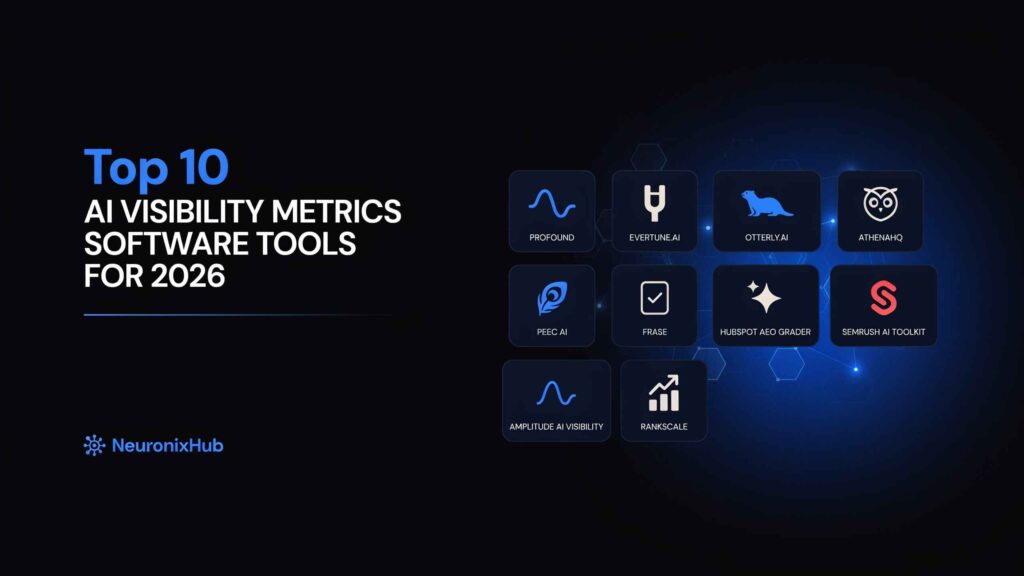
1. Profound — Best Overall for Accuracy
Profound has become one of the most-cited names in AI search visibility, and for good reason — it goes deeper than mention-tracking. Its Answer Engine Insights show how AI engines actually represent your brand, while Prompt Volumes reveal the exact queries buyers use to find you, including query fan-out patterns. Agent Analytics adds something few competitors offer: visibility into how AI crawlers read and index your site, so you can fix retrieval issues before they cost you a citation. Pricing starts around $99/month for a ChatGPT-only Starter plan, with full multi-engine coverage requiring the Growth tier or a custom Enterprise plan. Among the most accurate AI visibility metrics software options we reviewed, Profound is the one built for teams that treat this as a serious, ongoing analytics function rather than a once-a-month check-in.
2. Evertune AI — Best for Enterprise Teams
Evertune tracks brand presence across ChatGPT, Claude, Gemini, Perplexity, Meta AI, and DeepSeek, then connects that data to organic rankings, traffic, and social analytics through GA4 and its sister platform, Planable. For enterprise teams, that cross-channel context matters more than a standalone AI score — it shows whether an AI visibility dip correlates with a real shift in traffic or rankings elsewhere. It also includes competitive benchmarking with citation frequency and sentiment tracking against named rivals, plus full-suite SEO infrastructure like site audits and backlink analysis, making it a strong single-vendor option for larger marketing organizations.
3. Otterly.ai — Best for Small Businesses / Budget-Friendly
Otterly is the cheapest entry point in the category, with a Lite plan starting around $29/month covering 15 tracked prompts across ChatGPT, Google AI Overviews, Perplexity, and Copilot. The Standard plan scales up to 100 prompts with Google Looker Studio integration for teams that want to build their own reporting dashboards. The trade-off: Gemini and Google AI Mode are priced as separate add-ons, so full coverage costs more than the sticker price suggests. Still, for a freelancer or small business testing the waters, it’s the most accessible way to start using AI visibility metrics software without a real budget commitment.
4. AthenaHQ — Best for Multi-Platform Tracking
AthenaHQ monitors brand mentions across a wide set of engines — often cited at eight or more, including ChatGPT, Perplexity, and Google AI Overviews — with a prompt library that lets teams define and track specific buyer-intent queries over time. Rather than stopping at a scoreboard, it leans into content gap analysis, showing exactly which topics competitors get cited for that your brand doesn’t. Its Self-Serve plan starts around $295/month, aimed at growth-stage teams that want both wide platform coverage and a clear roadmap for what to publish next.
5. Peec AI — Best for Competitor Benchmarking
Peec AI, a Berlin-based platform, tracks brand mentions across ChatGPT, Claude, Gemini, and Perplexity with a sharp focus on share-of-voice measurement against named competitors, separating explicit brand mentions from source-level citations. Its EU hosting and GDPR-aligned data handling make it a common pick for European teams and regulated industries. Unlimited users are included on every plan, removing the per-seat pricing that makes team-wide adoption expensive elsewhere. Pricing starts in the €85–95/month range depending on the source, scaling up through Enterprise tiers with custom engine add-ons.
6. Frase — Best for Content Optimization Insights
Frase refuses to stop at the alert. It tracks brand visibility daily across ChatGPT, Perplexity, Claude, Gemini, Google AI, Grok, Copilot, and DeepSeek, then feeds that signal directly into its research, drafting, and content-scoring tools — so when you drop out of an AI answer, the same platform helps you write the content to win it back. That closed-loop workflow makes it a strong pick for content and SEO teams who’d rather fix the gap in place than export data into a separate tool every time.
7. HubSpot AEO Grader — Best Free / Freemium Option
For teams not ready to commit to a paid subscription, HubSpot’s AEO Grader offers a free snapshot of how AI engines currently represent a brand, with an optional $50/month tier for ongoing monitoring. It won’t match the depth or update frequency of dedicated platforms, but as a no-cost starting point — especially for teams already inside the HubSpot ecosystem — it’s a reasonable way to get a first read before investing further.
8. Semrush AI Toolkit — Best for Agencies
Semrush folds AI mention tracking into its existing SEO suite, covering brand visibility across ChatGPT, Gemini, Perplexity, and Google AI Overviews alongside competitive benchmarking and share-of-voice metrics. For agencies already running client SEO reporting through Semrush, this means AI visibility slots into a workflow that’s already built, instead of requiring a new vendor, a new login, and a new export process per client. The AI Search add-on runs at roughly $89/month on top of a base Semrush plan — worth weighing against a dedicated tool if AI visibility becomes a core service line rather than an add-on.
9. Amplitude AI Visibility — Best API/Integration Support
Most AI visibility tools end at the mention. Amplitude starts there. It monitors brand presence across ChatGPT, Claude, Perplexity, and Google Gemini, then — through its existing integration with Amplitude Product Analytics and Web Analytics — connects those mentions to what actually happens next: whether AI-referred visitors activated, explored specific features, or converted. For teams already running Amplitude for product analytics, this turns AI visibility from an isolated number into part of the same behavioral data pipeline you already trust.
10. Rankscale — Best Emerging Tool to Watch
Rankscale has positioned itself as the budget challenger in this space, offering some of the broadest engine coverage and unlimited seats at entry prices reportedly as low as $20/month. It’s newer and less battle-tested than names like Profound or Peec AI, with thinner independent review coverage so far — but its combination of low cost and wide platform tracking makes it worth watching as it matures, particularly for teams priced out of the $200–400/month mid-tier.
Comparison Table: Top AI Visibility Tools at a Glance
Once you know what each tool claims, the real test is seeing them side by side. Pricing alone can mislead — a $29 plan and a $399 plan might track the same four platforms, just with different prompt limits attached. Among the tools we tested, accuracy tends to come down to two things: how many engines a tool monitors daily, and whether it validates citations rather than just counting mentions. Feature depth varies just as widely — Frase and Profound bundle API access into every plan, while others gate it behind enterprise tiers. Real-time monitoring is still the exception, not the norm. The table below breaks down all ten platforms by accuracy signals, published pricing, and core features, so you can see what you’re actually paying for before committing budget.
| Tool | Platforms Tracked | Update Frequency | API Access | Starting Price |
| Profound | ChatGPT, Gemini, Claude, Perplexity (tiered) | Daily | Yes (higher tiers) | ~$99/mo |
| Evertune AI | ChatGPT, Claude, Gemini, Perplexity, Meta AI, DeepSeek | Daily | Enterprise | Custom |
| Otterly.ai | ChatGPT, Google AI Overviews, Perplexity, Copilot | Daily | Limited | $29/mo |
| AthenaHQ | 8+ platforms incl. ChatGPT, Perplexity, AI Overviews | Daily | Yes | ~$295/mo |
| Peec AI | ChatGPT, Claude, Gemini, Perplexity | Daily | Enterprise add-on | ~€85–95/mo |
| Frase | ChatGPT, Perplexity, Claude, Gemini, AI Overviews, Grok, Copilot, DeepSeek | Daily | Yes (all plans) | $39/mo |
| HubSpot AEO Grader | Major AI engines (snapshot) | Manual/on-demand | No | Free / $50/mo |
| Semrush AI Toolkit | ChatGPT, Gemini, Perplexity, AI Overviews | Daily | Yes | +$89/mo add-on |
| Amplitude AI Visibility | ChatGPT, Claude, Perplexity, Gemini | Daily | Yes (native) | Custom |
| Rankscale | Broad multi-engine coverage | Daily | Limited | ~$20/mo |
Pricing reflects publicly available figures as of mid-2026 — confirm current rates on each vendor’s site before you buy, since plans in this category shift often.
Key Metrics to Look for in AI Visibility Software
A comparison table tells you what a tool costs and covers. It won’t tell you which numbers inside that tool actually matter. Four metrics separate the most accurate AI visibility metrics software from a dashboard full of vanity numbers.
Share of AI Voice / Mention Rate
This is your baseline: the percentage of tracked prompts where your brand appears at all, ideally benchmarked against named competitors rather than viewed in isolation.
Citation and Source Tracking Accuracy
A mention without a citation is a weak signal. Strong tools show exactly which page earned the reference, separating owned citations from third-party mentions you don’t control.
Sentiment and Brand Positioning Analysis
Appearing isn’t the same as appearing well. Sentiment tracking catches the cases where AI mentions you accurately but frames a competitor more favorably in the very same answer.
Prompt-Level Ranking Data
Finally, granular prompt-level data shows which specific queries you’re winning or losing — turning a single visibility score into an actual roadmap instead of a report card.
How to Choose the Right AI Visibility Tool for Your Business
Knowing which metrics matter still leaves one question unanswered: which tool fits your actual budget and team size. The right pick among the most accurate AI visibility metrics software options depends less on features and more on where your business sits right now.
For Solo Marketers and Startups (Otterly.ai, Rankscale)
If you’re testing whether AI visibility even matters for your category, start cheap. Otterly.ai and Rankscale both offer entry plans under $30/month — enough to see whether your brand shows up at all before committing serious budget.
For Mid-Size Companies (Peec AI, AthenaHQ, Frase)
Once visibility is a confirmed priority, mid-size teams need more than a scoreboard. Peec AI adds strong competitor benchmarking, AthenaHQ turns gaps into a content roadmap, and Frase closes the loop by pairing tracking with the optimization work needed to actually fix what it finds.
For Enterprise and Agency Use Cases (Profound, Evertune AI, Semrush AI Toolkit)
At enterprise scale, the calculus changes again. Profound and Evertune AI both offer the depth and cross-channel context large teams need to justify board-level reporting, while agencies already embedded in Semrush’s ecosystem can activate AI tracking without adding a new vendor to the client stack.
Common Mistakes to Avoid When Tracking AI Visibility
Choosing the right tool solves half the problem. The other half is using it correctly — and most teams stumble on the same three mistakes early on.
Relying on a Single AI Platform for Data
Tracking only ChatGPT feels sufficient until you realize Perplexity or Gemini describes your brand completely differently. Visibility varies sharply by engine, so single-platform data creates a distorted, overly narrow picture.
Ignoring Update Frequency and Data Lag
A weekly snapshot can miss a visibility swing that happened and reversed within days. If your tool refreshes slowly, you’re often reacting to outdated information without realizing it.
Confusing Traditional SEO Rankings with AI Visibility
Ranking first on Google guarantees nothing in an AI answer. The two systems pull from different signals entirely, and treating them as interchangeable leads teams to optimize the wrong thing while visibility quietly slips elsewhere.
Final Verdict: The Best Accurate AI Visibility Software for 2026
Here’s the uncomfortable truth this guide keeps circling back to: you can rank first on Google and still be invisible where a growing number of your buyers now search. That gap is the whole reason this category exists, and closing it starts with picking a tool that matches where you actually are, not where you wish you were.
Across every category we tested, Profound stood out as the most accurate AI visibility metrics software for teams ready to treat this as a real analytics function. Otterly.ai remains the smartest way to test the waters without real financial risk. And Evertune AI is the one to grow into once visibility stops being a side metric and becomes a board-level conversation. Whichever you choose, the mistake isn’t picking the “wrong” tool — it’s waiting another quarter to start measuring at all.
Our Top Pick Overall — Profound
Best Budget-Friendly Alternative — Otterly.ai
Best for Long-Term Scalability — Evertune AI
Frequently Asked Questions About AI Visibility Metrics Software
What is the most accurate AI visibility metrics software?
No single tool wins on every metric, but Profound leads on data depth and validation, Evertune AI leads on cross-channel accuracy, and Peec AI leads on citation-level precision.
How is AI visibility metrics software different from SEO?
SEO tools track keyword rankings and backlinks. AI visibility metrics software tracks whether and how AI engines like ChatGPT mention your brand in generated answers — an entirely separate data set.
How often should AI visibility metrics software update?
Daily monitoring is the safe minimum. Weekly snapshots often miss short-term swings, especially in competitive categories where AI answers shift week to week.
Can free AI visibility metrics software be accurate?
Free tools like the HubSpot AEO Grader offer a useful one-time snapshot, but they lack the daily, multi-engine tracking that paid platforms provide for ongoing accuracy.
Which platforms should AI visibility software track?
Prioritize ChatGPT, Google AI Overviews, Perplexity, and Gemini first — these four currently drive the largest share of AI-influenced brand discovery.