SEO used to mean hours buried in keyword spreadsheets, guesswork-driven content calendars, and technical audits that dragged on for days. That’s changed. AI has quietly become one of the most powerful forces in how marketers approach search visibility, helping teams spot ranking opportunities faster, write content that actually answers what people are searching for, and catch technical issues before they tank performance. If you’ve been wondering how to use AI for SEO without losing the judgment that search engines still reward, here’s the short answer: you don’t have to choose between the two.
The strongest SEO strategies in 2026 blend AI’s speed with human expertise and editorial control. The right tools can read search intent, draft data-backed content briefs, and flag technical errors in minutes instead of hours, which frees you up for the strategic and creative work AI still can’t do well. With so many AI SEO tools competing for your attention, knowing where to start is the real challenge. So let’s get into what using AI for SEO actually looks like in practice, beginning with how it’s reshaping the way this work gets done.
What Does It Mean to Use AI for SEO?
At its core, using AI for SEO means applying machine learning and natural language processing to tasks that used to eat up entire workdays: keyword research, competitor analysis, content optimization, technical troubleshooting. AI doesn’t replace your SEO strategy. It accelerates it, chewing through massive datasets in seconds and surfacing patterns a person scrolling through spreadsheets would likely miss.
How AI Is Changing Traditional SEO Workflows
The repetitive, time-consuming work, like scanning thousands of keywords, auditing site speed, or sorting topics into clusters, now happens largely in the background. That shift matters because it gives SEO professionals room to focus on strategy and creative decisions instead of data collection.
AI-Powered SEO vs. Manual SEO: Key Differences
Speed and scale are the real dividing line. Manual SEO leans on individual research and gut instinct. AI-powered SEO runs on real-time data and predictive modeling instead. That said, oversight still matters: AI can spot patterns, but it can’t replicate human judgment, brand voice, or the kind of strategic nuance that comes from actually knowing your audience.
Why You Should Use AI for SEO in 2026
Search algorithms keep getting more sophisticated, and clinging to manual processes is a real disadvantage at this point. AI gives marketers the speed and precision needed to keep pace with how people actually search today.
Faster Keyword Research and Content Ideation
AI tools scan search trends and build relevant keyword clusters in minutes, so your content calendar reflects actual demand instead of a hunch.
Smarter Technical SEO Audits
AI crawls full websites and flags broken links, slow-loading pages, and indexing problems far faster than a manual audit ever could, catching issues before they hurt your rankings.
Improved Content Optimization at Scale
From meta descriptions to internal linking suggestions, AI helps optimize multiple pages at once without sacrificing quality or consistency.
Better Search Intent Matching
By analyzing user behavior and query patterns, AI helps your content align more closely with what searchers genuinely want, which improves rankings and engagement together.
How to Use AI for SEO: A Step-by-Step Approach
Knowing the benefits is one thing. Putting them to work is what actually moves the needle. Here’s a practical framework for weaving AI into your SEO process from start to finish.
Step 1 – Use AI for Keyword Research and Topic Clusters
Start by identifying high-value keywords and organizing them into topic clusters. This gives your content strategy a clear, structured foundation to build from.
Step 2 – Generate AI-Assisted Content Briefs
Use AI to map out target subtopics, common questions, and gaps your competitors haven’t filled, so writers have direction before they open a blank document.
Step 3 – Optimize On-Page Elements with AI
Let AI suggest improvements to titles, meta descriptions, headers, and internal links to strengthen both relevance and readability.
Step 4 – Automate Technical SEO Audits
Run AI-powered crawls regularly to catch indexing errors, broken links, and site speed issues while they’re still small problems.
Step 5 – Track Rankings and Refine with AI Insights
Use AI analytics to monitor performance and adjust your approach based on real ranking data, not assumptions.
The Top AI Tools for SEO in 2026
With this many platforms on the market, it helps to know which ones genuinely deliver in each part of the SEO process, from research through optimization and outreach.
Best AI Tools for Keyword Research
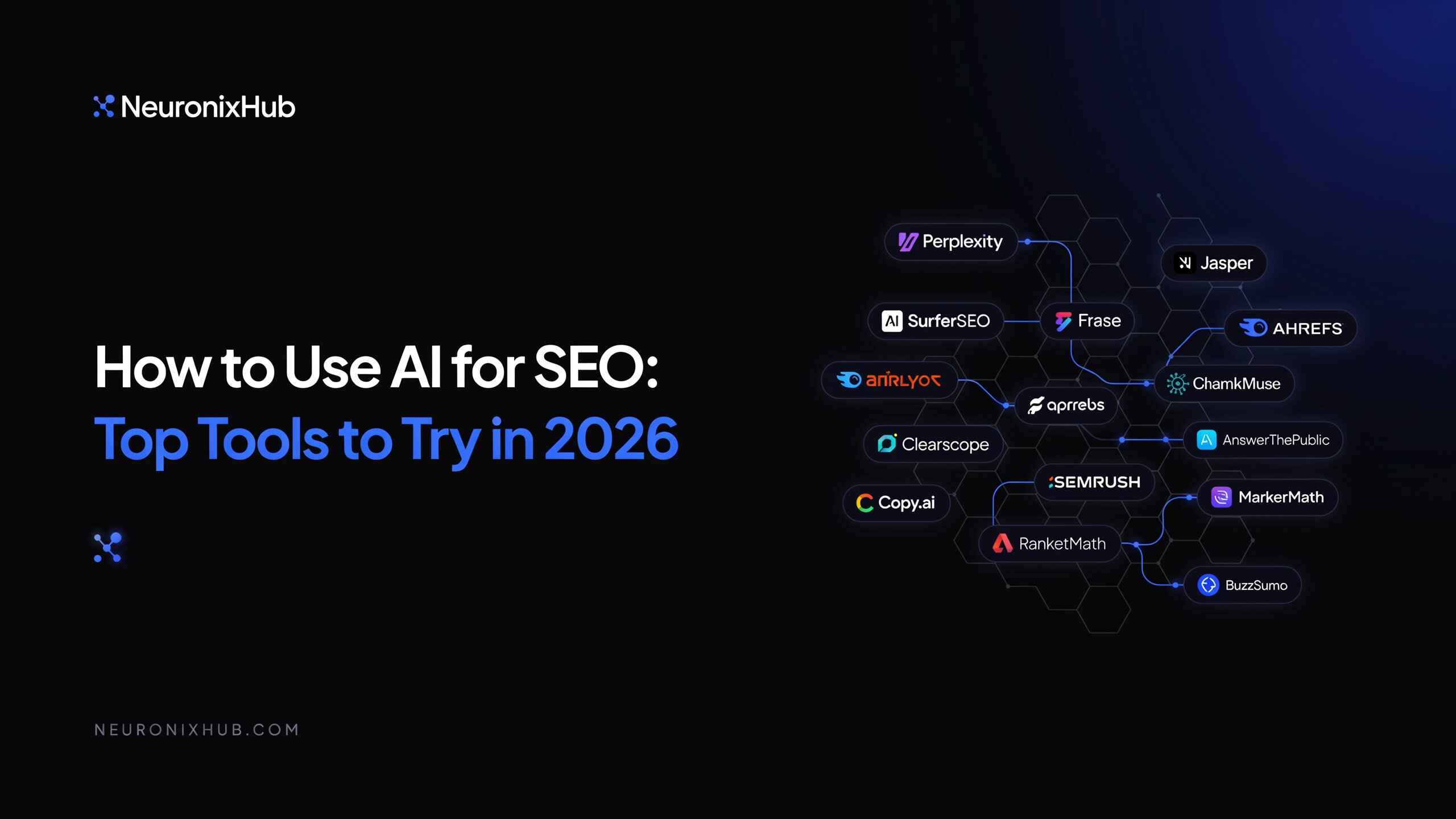
Ahrefs remains a strong pick here, built on a large and frequently updated backlink index that supports keyword discovery, content planning, and competitive analysis. Semrush stands out too, using AI-powered keyword clustering that groups terms by intent rather than surface-level similarity.
Best AI Tools for Content Creation and Optimization
Clearscope is a go-to for optimizing human-written content, scoring drafts against top-ranking competitors in real time. Surfer’s Content Editor analyzes top-ranking pages and guides word count, structure, and key terms, with features like Auto-Optimize and a live Content Score. Frase, meanwhile, is particularly strong when search intent is the priority.
Best AI Tools for Technical SEO
Alli AI automates site-wide technical fixes, including schema markup and broken-link repairs, all from a single dashboard.
Best AI Tools for Link Building and Outreach
Postaga uses AI to streamline backlink outreach, helping teams identify and connect with relevant link prospects more efficiently than manual outreach allows.
Best All-in-One AI SEO Platforms
Semrush One brings keyword research, competitor analysis, site audits, and AI visibility tracking across ChatGPT, Perplexity, and Google AI Mode into a single platform.
How to Choose the Right AI SEO Tool for Your Needs
With so many strong options out there, choosing the right way to use AI for SEO comes down to your goals, team size, and budget, not whichever tool has the loudest marketing.
Budget-Friendly vs. Enterprise AI SEO Tools
Solo bloggers and small businesses often do just fine with affordable, single-purpose tools built for keyword research or content optimization without extra bloat. Larger teams and agencies usually get more value from enterprise platforms that combine multiple functions, support several users, and offer deeper reporting.
Features to Look for in an AI SEO Tool
Whatever your budget, look for tools that integrate with what you already use, like Google Search Console, WordPress, or Google Docs. Accuracy matters just as much, so prioritize tools with reliable, frequently updated data. And don’t overlook ease of use: a powerful tool only helps if your team can actually act on what it recommends.
Common Mistakes to Avoid When Using AI for SEO
Picking the right tools is only half the job when you use AI for SEO. How you use them matters just as much, and a few common missteps can quietly erode your results.
Over-Relying on AI-Generated Content
Publishing AI output without meaningful human input tends to produce generic, repetitive content that fails to stand out, no matter how well it’s technically optimized.
Ignoring E-E-A-T Guidelines
Google continues to prioritize Experience, Expertise, Authoritativeness, and Trustworthiness. Content that lacks genuine expertise or real-world insight struggles to rank or earn reader trust, regardless of how polished it looks on the surface.
Neglecting Human Review and Editing
AI tools can miss context, nuance, or basic factual accuracy. Skipping human review raises the risk of errors, awkward phrasing, or content that doesn’t sound like your brand. Treat AI as a starting point, not a finished product, and your quality, accuracy, and authenticity stay intact.
The Future of AI and SEO Beyond 2026
As AI keeps evolving, the tools and tactics that work today will likely look different in a few years, which makes adaptability just as valuable as whatever best practice is trending right now.
How Search Engines Are Adapting to AI Content
Search engines like Google and Bing have sharpened their focus on originality, transparency, and genuine user value, rather than simply checking who or what wrote a piece of content. Instead, they’re increasingly evaluating how content was made, why it exists, and whether it actually helps the person reading it, with real-world experience and demonstrated expertise carrying more weight than ever.
Predictions for AI-Driven SEO Strategies
Visibility is expected to depend less on page position and more on whether your brand gets cited inside AI-generated answers, which means marketers need to start optimizing for citations, not just clicks. Search Everywhere Optimization, including Generative Engine Optimization, is shaping up to be essential as discovery spreads across AI tools and platforms well beyond a single search engine. Businesses that get ahead of this now will be in a far better position as it accelerates.
Conclusion: Start Using AI for SEO Today
Knowing how to use AI for SEO isn’t about handing your strategy over to a machine. It’s about giving yourself room to think bigger. The teams winning in 2026 aren’t the ones with the fanciest tools; they’re the ones who let AI handle the heavy lifting of research, audits, and optimization while keeping real expertise, judgment, and voice at the center of everything they publish. Start small if you need to. Pick one tool from this guide, apply it to a single part of your workflow, and notice how much mental space opens up for the work only you can do. Search engines are getting better at rewarding genuine value over shortcuts. The brands that understand this distinction, and act on it now, won’t just rank better. They’ll build something worth ranking.
Frequently Asked Questions (FAQ)
How do I start using AI for SEO as a beginner? Start small by using one AI tool for keyword research or content optimization, then expand into technical audits and analytics as you get comfortable with the workflow.
Can AI fully replace SEO specialists? No. AI speeds up research and optimization, but strategy, creativity, and judgment still require human expertise to drive real results.
Is AI-generated content penalized by Google? Not inherently. Google penalizes low-quality, unhelpful content regardless of whether it’s AI-assisted, so focus on accuracy, originality, and genuine value.
What’s the best free AI tool for SEO beginners? ChatGPT is a strong free starting point for keyword brainstorming and content ideas, especially paired with a dedicated SEO platform’s free tier.
How long does it take to see AI SEO results? Most businesses see measurable improvement within 3 to 6 months, depending on competition, content quality, and how consistently you optimize.