Running a business today feels like being pulled in ten directions at once. You’re expected to publish content on a schedule, run ads that convert, personalize emails for thousands of subscribers, and answer customers instantly, all while keeping the rest of the business running. Hiring your way out of that pressure isn’t realistic for most companies, and increasingly, it isn’t necessary. AI has changed what a small team can do, turning work that once took a full department into something one person can manage well, without cutting corners or losing the personal touch customers notice.
That’s the real story behind scaling your marketing with AI for business growth: it’s not a trend, it’s become a practical requirement. Companies that used to rely on gut feeling now use AI to predict customer behavior, automate the repetitive parts of their workflow, and personalize experiences at a scale no manual process could match. The businesses pulling ahead in 2026 aren’t working harder. They’re working with better tools, applied deliberately. So what does that actually look like, and why has it become non-negotiable? Let’s get into it.
Why AI Is Now Essential for Marketing Growth
The Shift from Manual Marketing to AI-Driven Strategy
Marketing used to run on spreadsheets, guesswork, and slow trial-and-error to figure out what resonated. Now AI reads patterns in real time, swapping months of manual testing for decisions grounded in live data that adjusts as customer behavior shifts.
Key Challenges AI Solves for Growing Businesses
Tight budgets, small teams, and not enough hours in the day are what stall most growing companies. AI takes on the repetitive load directly, automating content production, ad optimization, and audience segmentation, so a lean team can produce results that used to require a much bigger department.
What “Scaling with AI” Actually Means
Scaling with AI isn’t about replacing human creativity. It’s about handing off the repetitive, data-heavy work to intelligent tools so your team’s time goes toward strategy, storytelling, and the relationships that actually build a brand, while AI quietly runs in the background.
How AI Helps You Scale Marketing Without Scaling Your Team
Automating Repetitive Tasks (Content, Ads, Emails)
Writing captions, scheduling posts, adjusting ad bids, sending follow-ups: none of it is glamorous, and all of it eats time. AI takes this on continuously, so your team stops firefighting daily busywork and starts actually thinking about strategy again.
Personalization at Scale
Customers can tell the difference between a form email and one that actually reflects their interests. AI reads browsing behavior, purchase history, and engagement patterns to tailor emails, recommendations, and ads for thousands of people at once, at a level no human team could realistically replicate by hand.
Data-Driven Decision Making and Predictive Insights
Instead of waiting until a campaign wraps to see what worked, AI surfaces performance signals while the campaign is still running. That means you can shift budget, messaging, or targeting mid-flight, cutting wasted spend and improving results based on what’s actually happening, not what you assumed would happen.
The Top AI Marketing Tools for Business Growth in 2026
Best AI Tools for Content Creation
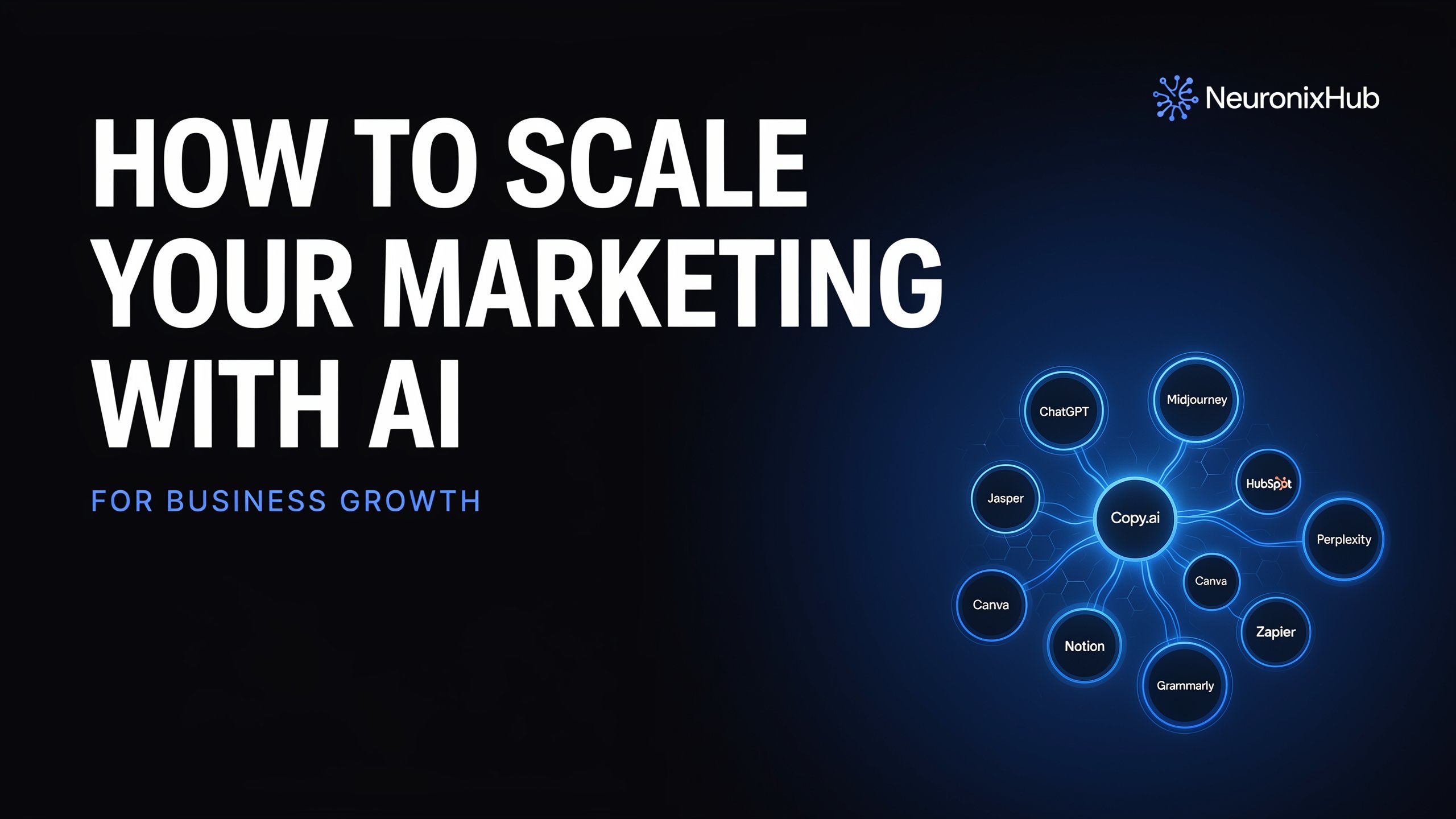
For strategy and copy, tools like ChatGPT and Claude have become standard; for visuals, Canva and Adobe Firefly let teams generate polished assets fast, without needing a dedicated designer on staff for every request.
Best AI Tools for Social Media & Advertising
Hootsuite, Buffer, and Metricool handle scheduling and reporting across platforms, while Meta’s and Google’s built-in AI features now optimize targeting and bid adjustments automatically, often outperforming manual settings.
Best AI Tools for Email Marketing & Automation
HubSpot, Zapier, and Make connect your workflows together, personalizing sequences and triggering campaigns based on what a customer actually does, not a fixed calendar date.
Best AI Tools for SEO & Analytics
Surfer SEO scores your drafts against what’s already ranking for a given keyword, while Similarweb tracks where your traffic is really coming from and how you stack up against competitors, in one dashboard instead of five.
Best AI Tools for Customer Service & Chatbots
AI-powered chatbots now field routine questions instantly, day or night, so your support team can spend their attention on the complicated cases that actually need a human.
How to Choose the Right AI Marketing Tools for Your Business
Matching Tools to Your Business Size and Goals
A solo founder and a 50-person marketing team don’t need the same setup. Smaller businesses usually do better with an all-in-one platform, while larger teams often get more value from specialized tools built for one job each.
Budget Considerations: Free vs. Paid AI Tools
Free tiers are fine for testing a tool or handling light workloads, but most growing businesses outgrow them within a few months. Paid plans typically unlock higher automation limits, deeper analytics, and integrations that pay for themselves in time saved.
Integration with Your Existing Marketing Stack
An AI tool that doesn’t talk to your CRM, email platform, or analytics setup isn’t saving you anything. Check integration options before you commit, since a disconnected tool just creates more manual work, the opposite of what it’s supposed to do.
Step-by-Step: How to Scale Your Marketing with AI
Step 1 – Audit Your Current Marketing Workflow
Before you touch a new tool, map out where your time actually goes. Flag the repetitive tasks, the bottlenecks, and the gaps in your current process, that audit tells you exactly where AI will create the most value.
Step 2 – Identify High-Impact Areas for AI Automation
Not everything needs automating. Focus first on high-volume, repetitive work, content drafts, ad tweaks, email segmentation, where AI saves real hours without putting quality or oversight at risk.
Step 3 – Test and Implement AI Tools Gradually
Don’t rebuild your entire stack in one week. Pick one workflow, run it alongside what you’re already doing, and confirm it actually moves the needle before you expand or add another tool on top.
Step 4 – Measure ROI and Optimize Continuously
Track numbers that matter, engagement, conversions, hours saved, not vanity metrics. Use what you learn to adjust prompts, tighten settings, and keep improving as your AI marketing setup matures.
Common Mistakes to Avoid When Scaling Marketing with AI
Over-Automating and Losing the Human Touch
It’s easy to get carried away once automation starts working. But customers notice when messaging feels canned. Keep AI focused on efficiency, and let people handle the empathy, the storytelling, and the moments that call for a genuine human response.
Ignoring Data Privacy and Compliance
AI tools often touch sensitive customer data, so privacy isn’t optional. Read each platform’s data handling policy, confirm it meets regulations like GDPR, and don’t feed a tool information you haven’t checked is safe to share.
Relying on a Single Tool Instead of a Connected Stack
No AI tool does everything well. Businesses that lean on just one platform tend to hit a ceiling fast. Build a connected stack instead, where each tool does what it’s actually good at, so your setup stays flexible as your needs change.
The Future of AI in Marketing: What to Expect Beyond 2026
Emerging AI Marketing Trends to Watch
Marketing is moving toward agentic AI, systems that plan, execute, analyze, and optimize entire campaigns instead of handling one task at a time. Expect sharper personalization, predictive campaign modeling, and AI acting with increasingly less hand-holding.
How to Future-Proof Your Marketing Strategy
Staying competitive means treating AI as infrastructure, not a tool you dip into occasionally. That means integrating it across planning, content, engagement, and measurement, not experimenting with disconnected platforms. Clean data matters more than ever, since every AI capability depends on it, and your team’s skills need to keep pace as the tools evolve. Above all, keep a human in the loop. As automation gets more capable, the businesses that balance efficiency with real judgment and creativity will keep outperforming the ones that let AI run on autopilot. Build for adaptability, not for whatever’s working today, because it’ll likely look different a year from now.
Conclusion: Start Scaling Your Marketing with AI Today
Scaling your marketing with AI isn’t about chasing every new tool that launches. It’s about being deliberate: auditing what actually needs your attention, automating the repetitive work eating your time, and holding onto the human judgment that makes your brand feel real. The businesses pulling ahead in 2026 aren’t the ones with the biggest budgets, they’re the ones treating AI as a genuine partner in strategy, not a substitute for it. Start small. Pick one workflow, one bottleneck, one place AI can hand you back real hours, and build outward from there. The tools will keep changing. The businesses that thrive will be the ones that stayed curious, stayed adaptable, and never lost sight of the people behind every data point.
Frequently Asked Questions About Scaling Marketing with AI
How can AI help scale your marketing for growth?
AI scales marketing by automating repetitive work, content creation, ad optimization, email personalization, so your team can focus on strategy while AI handles the high-volume, data-driven tasks.
What’s the best AI tool for small business marketing?
There isn’t one universal answer. All-in-one platforms like HubSpot tend to work well for small businesses that want content, automation, and analytics in a single place instead of juggling several subscriptions.
How much does AI marketing software typically cost?
It varies. Many tools offer a free tier for basic use, while paid plans generally run from around $15 to $100+ a month, depending on features, usage limits, and integrations.
Can AI replace a marketing team for business growth?
No. AI is excellent at repetitive, data-heavy work, but strategy, creativity, and genuine customer relationships still need a human behind them. It’s a powerful complement, not a replacement.
Is scaling marketing with AI worth it for startups?
Yes. AI lets startups compete with bigger, better-funded companies by automating work that would otherwise require additional hires, making it especially valuable for small teams on tight budgets.