Every growing business hits the same wall eventually. The processes that worked fine with five clients or a two-person team suddenly buckle under real volume. Tasks pile up, response times slip, and your best people spend more time on repetitive busywork than on the strategic decisions that actually move the needle. If that sounds familiar, you’re not stuck — you’re just outgrowing systems that were never built to scale in the first place.
This is exactly the gap that Droven IO AI automation tools are designed to close. Instead of throwing more hours or more hires at an inefficient process, these tools help you redesign how work actually moves through your business — connecting your existing software, automating the repetitive parts, and freeing your team to focus on higher-value decisions. Whether you’re a solo founder or running a growing team, learning how to scale your workflows with Droven IO AI automation tools can be the difference between constantly playing catch-up and building something that grows without falling apart. Let’s start with what workflow scaling actually means — and why so many teams get it wrong.
What Is Workflow Scaling, and Why Does It Matter?
Workflow scaling is the ability of your processes to handle more volume, more clients, and more complexity without falling apart or demanding proportionally more manual effort from your team. It’s the line between growth that feels sustainable and growth that feels like a constant fire drill.
Signs Your Current Workflows Are Holding You Back
The warning signs usually show up before you can name the actual problem: tasks slipping through the cracks, two people unknowingly doing the same job, approvals stuck in a forgotten email thread, and a team that runs on “someone will remember” instead of a system that just works.
The Cost of Manual, Unscalable Processes
Manual work doesn’t just eat time — it quietly eats money. Every hour spent on repetitive data entry or status chasing is an hour not spent on strategy, sales, or the customer relationships that actually grow revenue. Left unchecked, these small inefficiencies compound, which is exactly why scaling starts to feel so much harder than it should.
What Is Droven IO?
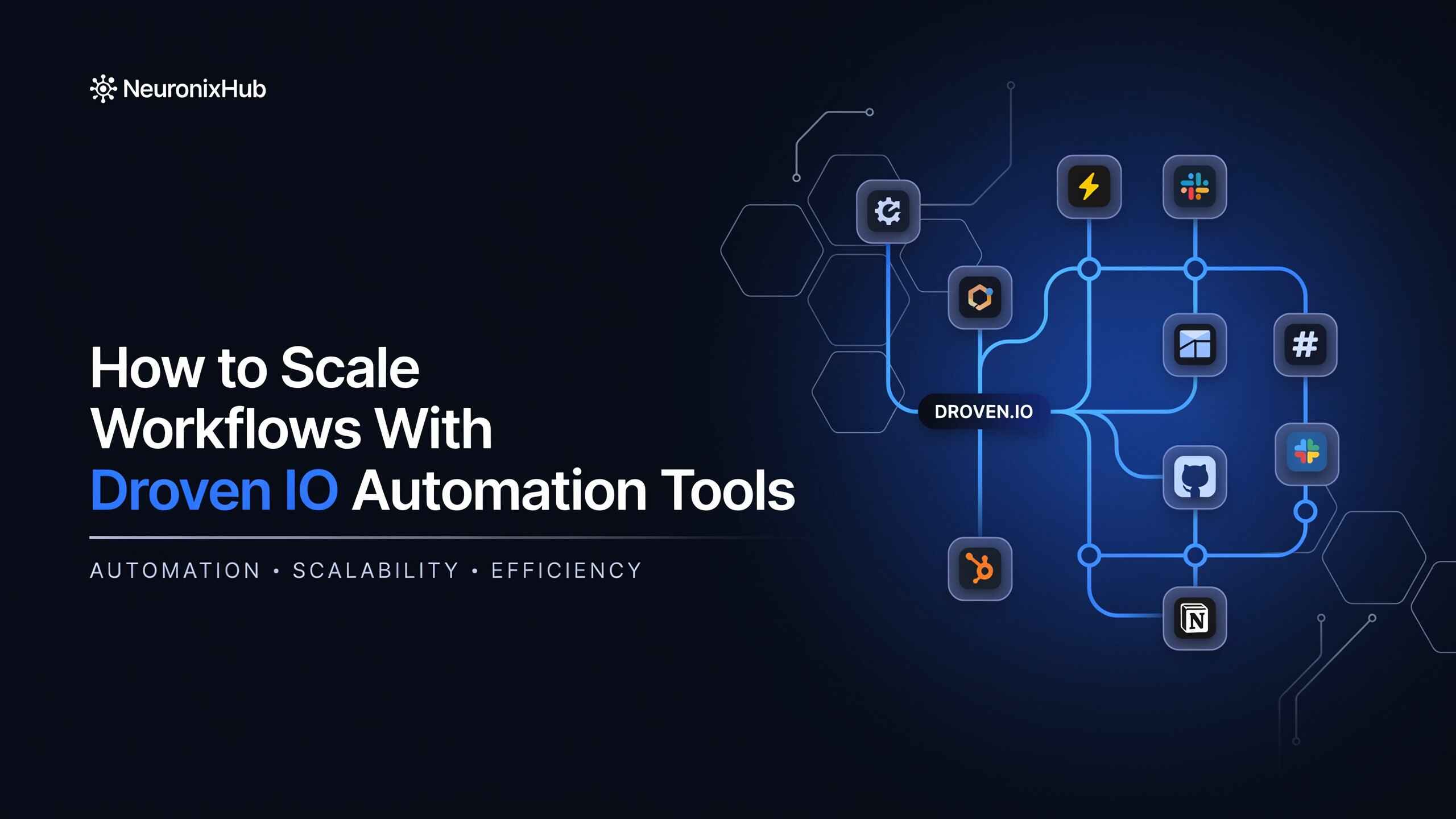
Droven IO AI automation tools function as an AI-driven layer that sits across your existing software, helping you connect systems, move data automatically, and cut down on manual handoffs between teams. Rather than treating automation as a single rigid script, the approach leans on AI to make workflows adaptive — routing tasks, prioritizing actions, and adjusting on the fly instead of breaking the moment something changes upstream.
Core Features and Capabilities
At a practical level, Droven IO AI automation tools typically bring together intelligent workflow triggers, cross-platform integrations, real-time data syncing, and automation rules you can customize as your business changes — so you’re not stuck rebuilding your setup every time a process shifts.
How Droven IO Differs From Other Automation Platforms
Traditional automation tools follow fixed, rule-based logic: if X happens, do Y, and nothing more. Droven IO AI automation tools go a step further by using AI to interpret context, not just execute static commands. In practice, that means fewer broken workflows when inputs change, less custom coding to maintain, and automation that keeps working as your business scales rather than requiring a rebuild every quarter.
Key Benefits of Using Droven IO to Scale Workflows
Once your workflows are automated, the payoff shows up fast — and it compounds the bigger your team gets.
Time and Cost Savings
Automating repetitive tasks hands teams back the hours they used to lose to data entry, status updates, and follow-ups. That time gets redirected toward revenue-generating work, while lower administrative overhead trims operational costs.
Reduced Human Error
Manual processes are prone to small, expensive mistakes — a missed field, a duplicate entry, a skipped step. Automation applies the same logic every single time, cutting down on the errors that quietly disrupt operations or chip away at client trust.
Improved Team Collaboration and Visibility
Centralized workflows mean everyone is working off the same real-time information. Handoffs get smoother, ownership gets clearer, and teams stop wasting time chasing updates across five different tools and inboxes.
Faster Decision-Making With Real-Time Data
Live dashboards and instant reporting mean decisions are based on what’s happening right now, not a snapshot from three days ago — which matters when conditions on the ground shift quickly.
How to Scale Your Workflows With Droven IO (Step-by-Step)
Scaling successfully isn’t about automating everything overnight. It’s about following a process you can repeat and improve on.
Step 1 — Audit Your Existing Workflows
Map your current processes end to end. Pin down exactly where time gets lost, where handoffs break down, and which tasks are repetitive but essential to keep the business running.
Step 2 — Identify High-Impact Automation Opportunities
Not every task is worth automating. Prioritize high-volume, low-complexity processes first — these are the quick wins that build momentum and buy-in for a bigger rollout later.
Step 3 — Set Up Droven IO Integrations
Connect Droven IO AI automation tools to the software you already run on — your CRM, your email platform, your project management system — so data flows between them automatically instead of being copied by hand.
Step 4 — Build and Customize Automation Rules
Configure triggers and rules that actually reflect how your team works day to day, and plan to revisit that logic as your processes evolve.
Step 5 — Test, Monitor, and Optimize
Run new automations on a small scale first, keep a close eye on performance, and refine based on what the data actually shows before rolling out further.
Best Practices for Scaling Automation Without Losing Control
Automation should sharpen your team’s judgment, not replace it outright. A few practices keep growth sustainable instead of chaotic.
Balancing Automation With Human Oversight
Even well-built automation needs a clear escalation path. Build in checkpoints where a person reviews outcomes — especially for customer-facing or high-stakes decisions — so a small error doesn’t snowball into a bigger one.
Avoiding Common Automation Pitfalls
The most common mistake is trying to automate everything at once. Start with one workflow, prove it out, then expand. Skipping that step is how businesses end up with fragmented systems that create more confusion than they solve.
Setting KPIs to Measure Automation Success
Before you scale further, decide what success actually looks like. Track time saved, error rates, response times, and cost per task. These numbers tell you honestly whether your automation is improving operations — or just adding complexity without real payoff — so you can course-correct early.
Real-World Use Cases for Droven IO Automation
Automation proves its value fastest when it’s applied to the everyday work teams already do.
Marketing Workflow Automation
Marketing teams use Droven IO AI automation tools to schedule campaigns, segment audiences, and trigger personalized follow-ups based on customer behavior — cutting manual busywork while keeping messaging timely and relevant.
Sales and CRM Automation
Sales teams benefit from automated lead scoring, follow-up reminders, and real-time CRM updates. Fewer leads slip through the cracks, and reps spend more time selling instead of updating spreadsheets.
Operations and Internal Process Automation
Behind the scenes, automation handles invoice approvals, document routing, and internal reporting — the repetitive work that quietly eats hours every week. Streamlining these processes reduces bottlenecks and frees up staff for higher-value work that actually supports growth.
Droven IO Pricing and Plans
Pricing for automation platforms generally scales with usage, features, and team size, so it’s worth understanding the general structure before committing to a plan.
Which Plan Is Right for Your Team Size
Solo founders and small teams often start with a basic or entry-level tier, ideal for automating a handful of core workflows without a big upfront investment. Growing businesses with multiple departments usually move to mid-tier plans, which typically unlock higher usage limits, more integrations, and deeper customization. Larger organizations with complex, high-volume operations may need enterprise-level plans built around dedicated support, custom workflows, and stronger security and compliance controls. The right plan comes down to how many processes you’re automating, how many people need access, and how deeply automation needs to run across your departments.
Frequently Asked Questions
Is Droven IO AI Automation Good for Small Businesses?
Yes. Droven IO AI automation tools are flexible enough to scale down for smaller teams, letting you automate one or two high-impact processes without needing a large budget or a technical team behind you.
How Long Does Droven IO Setup Take to Complete?
Setup time varies with complexity, but most businesses can get their first workflow automated within days rather than weeks, especially starting with a single, well-defined process.
Does Droven IO Integrate With Existing Business Tools?
Yes. Droven IO AI automation tools are built to connect with common software like CRMs, email platforms, and project management tools, so data syncs automatically across your existing stack.
How Much Does Droven IO AI Automation Really Cost?
Pricing depends on usage, features, and team size, with most plans offering tiered options. Confirm current pricing directly with Droven IO before making a final decision.
Can Droven IO Automation Scale With My Business?
Yes. It’s designed to grow with you — start with simple workflows and expand into more advanced, higher-volume automation as your business needs increase.
Final Thoughts: Getting Started With Droven IO
Scaling your workflows was never really about doing more — it’s about doing the right things without burning out your team along the way. Droven IO AI automation tools give you a way to reclaim hours lost to repetitive tasks, cut down on costly errors, and give your team room to focus on work that actually matters. The businesses that grow smoothly aren’t the ones with the most tools; they’re the ones that automate on purpose, starting small and building momentum on real results. If your current processes feel held together with sticky notes and good intentions, that’s not a sign you need to work harder — it’s a sign your systems are overdue for an upgrade. Start with one workflow, prove the value, and let the rest of your growth follow from there.