

Remember the last time a website made you wait? You probably didn’t wait long. You hit the back button and found what you needed somewhere else. That split-second decision happens millions of times a day, and it’s exactly why speed became one of the web’s most quietly competitive battlegrounds.
Behind every page that loads instantly, there’s a stack of engineering most visitors will never notice: smarter caching, leaner code, and increasingly, AI doing work no human team could keep up with manually. These are the tech ideas that made the web move quicker, even though nobody’s clicking a “thank you” button for them. Before we rank the tools responsible, it’s worth understanding what’s actually at stake when a website falls behind.
In 2026, AI stopped being an experimental add-on and became a genuine performance engine, quietly compressing images, predicting what to cache, and flagging inefficient code before it slows anyone down. These tools aren’t technical curiosities. They’re solving a real, expensive problem: businesses losing visitors and revenue to pages that just take too long.
Why Web Speed Matters More Than Ever in 2026
Before ranking the tools, it helps to understand why speed carries this much weight in the first place — and why the tech ideas that made the web move quicker became a business priority rather than a developer’s pet project.
The Real Cost of a Slow Website (Bounce Rates, SEO, Revenue)
A slow site doesn’t just annoy visitors — it costs money. Even a one-second delay can measurably drop conversions, and Google still treats page speed as a genuine ranking factor. Slow load times drain traffic and revenue long before most businesses ever notice the leak.
How AI Has Changed the Performance Game
Old-school optimization ran on fixed rules: set a cache duration, compress an image once, move on. AI broke that pattern. It learns from actual traffic, device types, and user behavior, then adjusts in real time, catching problems a static rule would sail right past.
What “Fast” Means to Users Today (Core Web Vitals & Beyond)
Speed isn’t just “how long until the page appears” anymore. Users expect pages that feel responsive the moment they land, measured through metrics like Largest Contentful Paint and interaction delay — not just whether the spinner disappears quickly.
Key Innovations Behind Faster Web Experiences
These are the actual tech ideas that made the web move quicker in 2026 — not vague buzzwords, but specific engineering shifts you can point to.
AI-Powered Caching and Predictive Loading (Cloudflare, Fastly, Cachee)
Instead of reacting to traffic, modern CDNs now anticipate it. Cloudflare, Fastly, and Cachee analyze usage patterns and pre-warm caches before demand hits, cutting cache-miss penalties and keeping pages steady even during sudden spikes.
Smarter Image and Media Compression (ShortPixel AI, Squoosh)
Images are still the heaviest part of most pages. ShortPixel AI and Squoosh use AI to make per-image decisions on format and quality, often shrinking file size by 60-80% with no visible difference to the eye.
Edge Computing Meets Machine Learning (Akamai, BlazingCDN)
Running inference closer to the user cuts out the round trip to a distant server entirely. Akamai and BlazingCDN push decisions to the edge, shaving off the latency that used to be baked into every request.
Automated Code Optimization Tools (Claude Code, Cursor)
Claude Code and Cursor help developers spot inefficient loops, redundant API calls, and bloated dependencies — turning cleanup that once took days of manual review into a guided, largely automated process.
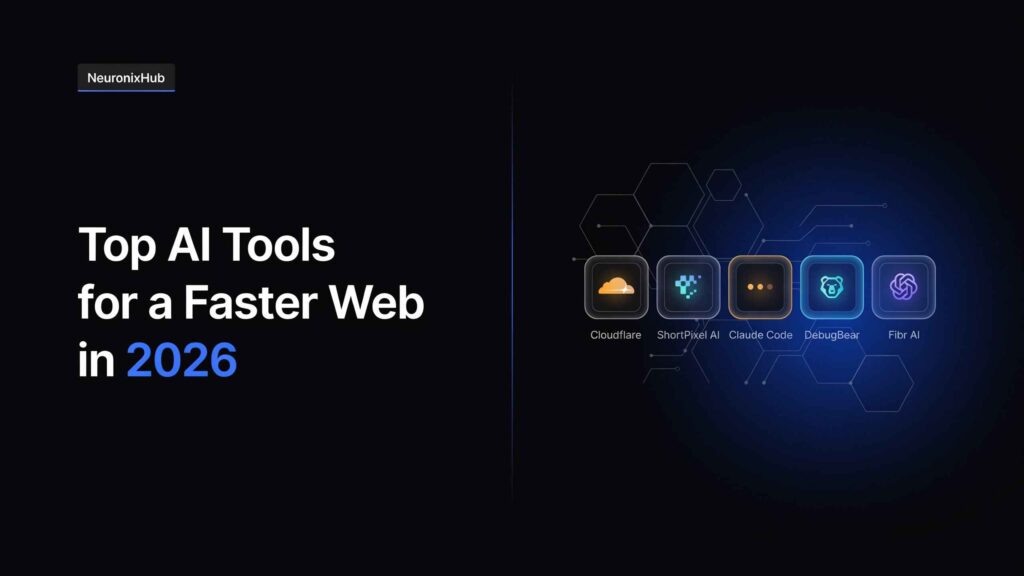
Top AI Tools for a Faster Web in 2026
Here’s a closer look at the specific tools behind the tech ideas that made the web move quicker this year — what each one does well, what it costs, and who it’s actually built for.
Cloudflare — Best for AI-Driven Edge Caching and Predictive Routing
Cloudflare is still the benchmark for AI-powered delivery. Its Cache Rules engine gives fine-grained control over TTLs, cache keys, and eligibility based on headers, cookies, and query strings, while cached responses can cut latency by up to 90% by serving repeat requests straight from Cloudflare’s global network.
- Key features: global edge network, unmetered DDoS protection, Workers for edge-side logic
- Pricing: free tier available; paid plans scale with traffic
- Best for: sites with a global audience that need consistent low latency everywhere
ShortPixel AI — Best for Automated Image Compression on WordPress
For WordPress sites buried under oversized media, ShortPixel AI does the heavy lifting. Real-world testing shows 60-85% file size reduction when converting JPEGs to WebP with AI Lossy compression, and 40-60% on PNGs.
- Key features: bulk optimization, automatic WebP/AVIF conversion, backup-and-restore for originals
- Pricing: free tier for smaller sites; paid plans for higher image volumes
- Best for: WordPress owners who want compression handled without touching a single setting
Claude Code — Best for Large-Scale, Repository-Wide Code Refactoring
When performance problems are buried in the codebase itself, Claude Code takes on the grunt work. It scores highest among tested tools for refactoring strength and repository-wide context, making it especially strong for large migrations and systematic cleanup across many files.
- Key features: full-codebase context, multi-file refactors, test-driven changes
- Pricing: included with Claude Pro subscriptions
- Best for: engineering teams tackling technical debt across large, sprawling projects
DebugBear — Best for Continuous Performance Monitoring and Alerts
You can’t fix what you don’t measure. DebugBear runs synthetic, Lighthouse-based testing that delivers consistent, repeatable results — a useful complement to real-user monitoring tools like Vercel Analytics or Sentry, which show what visitors actually experience.
- Key features: synthetic testing, historical trend tracking, regression alerts
- Pricing: roughly $50-150/month for small teams
- Best for: teams that want to catch a slowdown before customers do
Fibr AI — Best for AI-Driven Personalization and Conversion Optimization
Speed gets people to the page. Fibr AI is what turns that visit into a result, offering automated CRO, AI-driven experiments, and real-time personalization across landing pages at scale.
- Key features: no-code visual editor, bulk landing page generation, AI-search visibility scoring
- Pricing: tiered plans based on traffic and page volume
- Best for: marketing teams optimizing for speed and revenue at the same time
How to Choose the Right AI Tool for Your Website
Picking from these tech ideas that made the web move quicker isn’t about finding the one “best” tool — it’s about matching the right one to your setup.
Matching Tools to Your Tech Stack
Not every tool fits every site. A WordPress build benefits most from plugin-based solutions like ShortPixel, while custom-built platforms usually need edge or code-level tools instead. Check compatibility before you commit budget to anything.
Budget vs. Performance Trade-offs
Free tiers cover most small sites just fine. Growing traffic usually forces the upgrade conversation — at that point, weigh the monthly cost against what slow pages are already quietly costing you in lost visitors and abandoned carts.
Scalability for Growing Traffic
A tool that handles today’s traffic smoothly can still buckle under next year’s growth. Favor solutions built on distributed infrastructure that scale automatically, rather than ones that need a manual upgrade every time visitor numbers jump.
Most fast, resilient sites don’t rely on a single tool — they layer several: caching here, compression there, monitoring running underneath all of it. That combination is stronger than any one piece alone, but it only works if you avoid a few common traps.
Common Mistakes to Avoid When Optimizing Site Speed with AI
Even the smartest tech ideas that made the web move quicker can backfire without a bit of human oversight.
Over-Relying on Automation Without Testing
AI tools are powerful, not infallible. Automated compression can occasionally over-compress an image; predictive caching can occasionally serve something stale. Spot-check results instead of assuming the automation always got it right.
Ignoring Mobile Performance
Desktop speed tells you half the story, at best. Mobile users deal with slower connections and less powerful hardware, so a page that loads instantly on a laptop can still crawl on a phone. Test both, separately, every time.
Skipping Regular Audits
Performance isn’t a one-and-done project. New content, new plugins, and shifting traffic patterns quietly reintroduce the exact slowdowns you already fixed. Regular audits catch the regression before it costs you rankings or revenue.
None of these tools compensate for a “set it and forget it” mindset. Speed optimization works best as an ongoing habit — which is exactly the direction the next generation of tools is heading.
The Future of Web Performance: What’s Next After 2026
The tech ideas that made the web move quicker this year are just the opening chapter, not the finish line.
Emerging AI Trends in Site Optimization
Expect models to get more anticipatory, not just reactive. Federated learning will let systems train on-device without shipping raw data upstream, improving privacy while still sharpening predictions about what a user needs next — often before they’ve asked.
Predictions for the Next Wave of Speed Tools
Faster networks will keep pushing intelligence closer to the user. As edge infrastructure matures, real-time inference on behavior becomes the default, making personalization and delivery feel less like “loading” and more like the page was simply already there.
Analysts already expect AI-driven decisions to govern a growing share of CDN traffic in the next few years — a clear sign that today’s tools are still early. For site owners, that means nothing here is a finish line. It’s a starting point for a web that keeps getting quicker, and quieter about how it does it.
Final Thoughts: Building a Faster, Smarter Web
Speed was never really about milliseconds. It’s about trust — the quiet promise that a website will respect someone’s time the second they arrive. The tools covered here, from Cloudflare’s predictive edge caching to Claude Code’s repository-wide refactoring, show that AI isn’t just automating tedious work anymore. It’s anticipating problems before they surface, catching patterns a human team would miss entirely.
But no tool saves a website that treats speed as a checkbox instead of a habit. The sites that hold up won’t be the ones with the fanciest stack — they’ll be the ones that keep testing, auditing, and adjusting long after launch day. That’s the real legacy of the tech ideas that made the web move quicker: the web isn’t just faster now, it’s getting smarter about staying that way. The work is never really finished, and that’s what makes it worth doing properly.
Frequently Asked Questions
Quick answers to the most common questions about the tech ideas that made the web move quicker in 2026.
What tech ideas made the web move quicker in 2026?
AI-powered caching, image compression, and code refactoring lead the list. Tools like Cloudflare, ShortPixel AI, and Claude Code work together, handling delivery, media, and code efficiency at the same time instead of treating speed as a single fix.
Which AI tools help websites move quicker in 2026?
There’s no single “fastest” tool, since each one solves a different bottleneck. Cloudflare excels at edge caching, ShortPixel AI at image compression, Claude Code at cleaning up bloated code. Most fast sites combine several rather than betting on one.
Can AI make the web move quicker for SEO rankings?
Partially. Google treats speed as one ranking signal among several, so AI-driven performance gains help, but they work best paired with strong content and solid technical SEO — not as a standalone strategy.
Are these tech ideas worth it for small businesses?
Yes. Many AI speed tools offer free tiers that outperform manual optimization by a wide margin. Even basic AI-powered image compression or caching can meaningfully cut load times without hiring a developer.
Are free tools enough to make the web move quicker?
For smaller sites, often yes. Free tiers from tools like Cloudflare and ShortPixel AI cover most everyday performance needs. Higher-traffic sites eventually need paid plans, but starting free is a smart, low-risk first move.