Search split in two this year. Your content has to rank on Google’s results page and get cited when someone asks ChatGPT or Perplexity a question in your niche. Doing both by hand isn’t realistic anymore — that’s why so many marketers have switched to AI SEO tools. These platforms cover keyword research, content optimization, and tracking whether your brand actually shows up in AI-generated answers — work that used to eat up entire teams’ weeks.
Not every “AI-powered” tool is worth paying for, though. Some genuinely change how you research and write. Others just repackage data you could pull yourself and slap an AI label on it. After testing what’s actually driving results this year, we narrowed the field down to the AI SEO tools worth your budget. First, a quick look at what these tools actually do — and why they’ve stopped being optional.
What Are AI SEO Tools and Why Do They Matter in 2026?
AI SEO tools use artificial intelligence and large language models to handle work that used to take hours by hand: keyword research, content scoring, technical audits, and — new this year — tracking whether your brand shows up in AI-generated answers.
How AI Has Changed SEO Workflows
SEO used to mean optimizing for one search engine. Now your content has to satisfy Google’s algorithm and get referenced by ChatGPT, Perplexity, and Gemini. AI SEO tools analyze both at once, comparing your content against top-ranking pages and flagging gaps in real time.
Key Benefits of Using AI for SEO
The payoff is speed. A manual audit that used to take 40 hours now takes minutes. AI SEO tools also catch content opportunities a human researcher might miss entirely, which is how small teams end up competing with agencies ten times their size.
How We Evaluated the Best AI SEO Tools
Dozens of platforms call themselves the best AI SEO tool on the market. Most of that is marketing. Here’s what we actually checked.
Our Testing Criteria (Accuracy, Ease of Use, Pricing, AI Visibility Tracking)
We cross-checked every tool’s keyword data against Google Search Console — anything off by more than 15-20% got flagged. We also tested how usable each interface was for someone without an SEO background, whether pricing scaled fairly, and how well each platform tracked visibility across ChatGPT, Perplexity, and Google AI Overviews.
Who Each Tool Is Best Suited For
A solo blogger and a 20-client agency need completely different things from an AI SEO tool. So instead of ranking everything on one scale, we matched each platform to the user it actually serves best.
Top AI SEO Tools for 2026
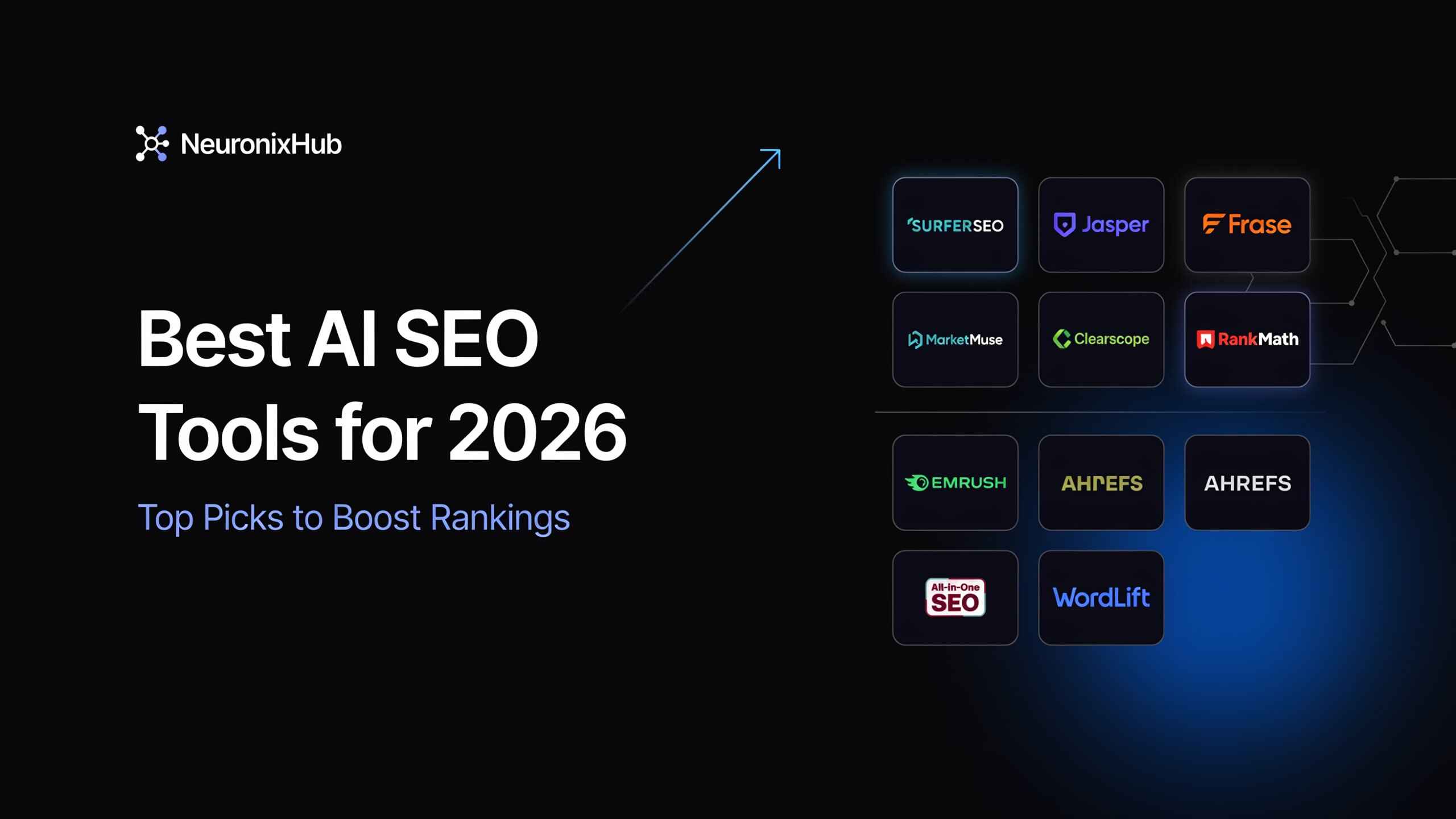
Nine platforms held up under testing. Each one wins in a different lane, so the right pick depends on your budget, team size, and what you’re actually trying to fix.
1. Semrush One — Best overall. Combines deep keyword data with AI visibility tracking across ChatGPT and Google AI Mode.
2. Ahrefs (Brand Radar) — Best for backlinks plus AI search tracking. Unmatched backlink index paired with serious LLM monitoring.
3. Surfer SEO — Best for content optimization. Real-time scoring as you write, benchmarked against top-ranking competitors.
4. Frase — Best for briefs. Dual SEO and GEO scoring in one workflow.
5. Clearscope — Best for polishing human-written content against what’s already ranking.
6. SE Ranking — Best value. A near-complete toolkit at a fraction of premium pricing.
7. Ubersuggest — Best budget pick, with a lifetime-access option for solo sites.
8. MarketMuse — Best for mapping topical authority and long-term content strategy.
9. Writesonic — Best all-in-one. Writing, SEO, and GEO tracking under one login.
AI SEO Tools Comparison Table
Numbers cut through the noise. Here’s how the top four AI SEO tools compare on cost and core capability.
Pricing Breakdown (Semrush One vs. Ahrefs vs. Surfer vs. SE Ranking)
Semrush One and Ahrefs sit at the premium end — that’s the cost of their databases and AI visibility depth. Surfer prices itself as a content specialist rather than a full suite. SE Ranking is the value play: comparable features to the bigger names, noticeably less money.
Feature-by-Feature Comparison (Content Optimization vs. AI Visibility Tracking)
Few AI SEO tools do both jobs equally well. Surfer and Clearscope lead on content optimization but track AI visibility lightly. Semrush One and Ahrefs flip that: strong content features plus deep AI Overview and citation monitoring. SE Ranking sits in the middle — solid at both, exceptional at neither.
Pricing shifts fast in this category — confirm current rates directly with each provider before you commit.
How to Choose the Right AI SEO Tool for Your Needs
The “best” AI SEO tool depends entirely on who’s using it and what’s actually broken.
For Solo Bloggers and Small Sites (e.g., Ubersuggest, Clearscope)
One site, no team, limited budget — simplicity beats depth here. Ubersuggest keeps costs down while covering the basics; Clearscope sharpens individual posts without extra features you’ll never touch.
For Agencies and Enterprise Teams (e.g., Semrush One, Ahrefs)
Managing multiple clients means you need scale, reliable data, and AI visibility tracking that works across accounts. Semrush One and Ahrefs earn their higher price tags here.
For Content-Heavy Teams (e.g., Frase, MarketMuse)
High publishing volume rewards tools built for research and planning. Frase speeds up brief creation; MarketMuse maps content gaps across an entire site — both save real hours at scale.
Common Mistakes to Avoid When Using AI SEO Tools
Good software doesn’t fix bad process. A few mistakes show up again and again, regardless of which platform someone’s using.
Trusting AI recommendations without question is the biggest one — these tools can misread intent or push keyword stuffing that reads badly, so every suggestion still needs a human check before publishing. Chasing a perfect content score instead of writing for the reader is a close second; a 100/100 score means nothing if the piece doesn’t actually answer the question. Teams also tend to configure an AI SEO tool once and forget it, missing new visibility features or algorithm shifts. And trusting one platform’s numbers without cross-checking Google Search Console is how bad decisions get made with confidence. AI SEO tools are a starting point — not a replacement for judgment.
Final Verdict: Our Top Pick for 2026
If we had to pick one, it’s Semrush One. It’s rare to find an AI SEO tool that pairs genuinely useful content optimization with visibility tracking that matters right now — knowing whether ChatGPT or Google AI Mode mentions your brand at all. But “best” is personal. A solo blogger doesn’t need what an agency needs, and Surfer or Ubersuggest might serve you better than any premium suite.
What matters more than the logo you pick is treating these tools as a starting point, not a shortcut. Search is splitting between traditional rankings and AI-generated answers, and the sites that adapt now — deliberately, not reactively — will be the ones still visible once things settle. The tools handle the heavy lifting. The judgment still has to be yours.
One note before you publish: pricing and features in this space shift monthly. Double-check current rates for Semrush One, Ahrefs, and SE Ranking before this goes live — especially in the comparison table.
Frequently Asked Questions
Can AI SEO tools fully replace human SEO experts?
No. AI SEO tools speed up research and optimization, but strategy and brand voice still need human judgment to avoid generic, off-target content.
What’s the difference between AI SEO and GEO tools?
AI SEO tools optimize for traditional Google rankings. GEO (Generative Engine Optimization) tools track and improve visibility inside AI-generated answers like ChatGPT and AI Overviews.
Do I need both an AI SEO tool and a visibility tracker?
Ideally, yes. Content tools like Surfer improve individual pages; visibility trackers like Ahrefs Brand Radar show whether AI platforms actually cite your brand.
Are AI SEO tools worth it for small businesses in 2026?
Yes — budget options like Ubersuggest automate audits and keyword research that most small teams can’t handle manually.
How much do AI SEO tools typically cost per month?
Anywhere from $29/month for budget tools to $200+ for premium platforms like Semrush One, depending on features and AI visibility depth.