Why This List Exists
Sit in on enough boardroom calls or investor pitches in 2026, and you’ll hear some version of the same question: which AI companies are actually worth paying attention to? It’s a harder question than it used to be, because at this point nearly every company claims to be “AI-powered.” Compiling the Droven.io Best AI Startups in USA list meant ignoring the marketing copy and looking at what’s underneath it — funding that’s actually landing, customers who are actually paying, and products that competitors are scrambling to copy rather than the other way around.
The gap between the leaders and everyone else didn’t happen by luck. It’s the result of deep venture capital reserves, a concentration of research talent that’s hard to replicate elsewhere, and enterprise buyers willing to bet on unproven technology years before it matures. This is the thinking behind Droven.io’s Best AI Startups in USA rankings below, along with the criteria we used to build the list and a few names worth watching before they hit unicorn status.
Three Trends Shaping the 2026 Landscape
Assistants are giving way to agents. A chatbot that answers a question is no longer impressive on its own. The real momentum this year is behind systems that plan, execute, and finish multi-step work with limited human oversight — the shift from AI as a helper to AI as an actual member of the workflow.
The U.S. funding gap keeps widening. American AI companies pulled in more than $100 billion in private investment this year — more than China and the UK combined. That capital keeps compounding: faster iteration cycles, more aggressive hiring, and a widening moat for whoever already has the lead.
The map is spreading beyond the Bay Area. San Francisco is still the center of gravity, but New York, Austin, and Boston have stopped being afterthoughts. Talent is following opportunity outside coastal California for the first time in years.
How We Picked This List
Every company that made the Droven.io Best AI Startups in USA cut had to clear three bars.
Funding quality, not just funding size. A Series B closed by Sequoia or a16z in late 2025 tells you something a stale 2022 seed round doesn’t. We weighted how recent the money is and who’s writing the checks — not just the headline total.
Revenue, not waitlists. Demos are cheap to produce and easy to fake enthusiasm for. What actually separates a durable company from a passing trend is whether real businesses are paying for the product and running it in production, day after day.
Category leadership. We asked whether each company is setting the terms other startups in its niche are now copying, or just moving fast in someone else’s slipstream. Everyone on this list belongs to the first group.
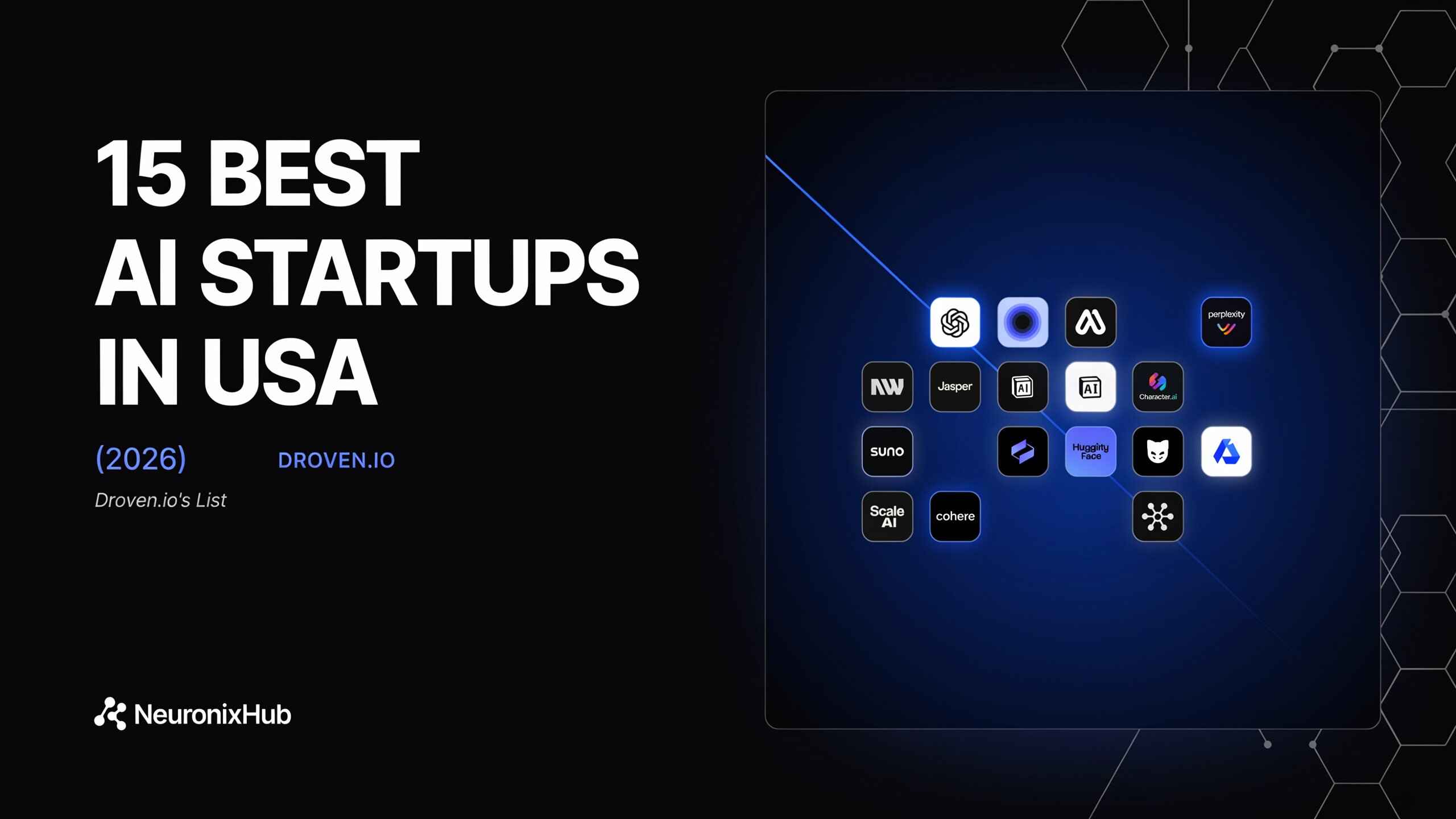
The Droven.io Best AI Startups in USA (2026) — Full List
Frontier Foundation Models
1. OpenAI — Still the Reference Point Everyone Gets Measured Against OpenAI’s valuation has crossed $500 billion, and its GPT-4o and o-series reasoning models now sit quietly inside enterprise software, consumer apps, and developer tooling across the industry. What separates OpenAI in 2026 isn’t raw model horsepower anymore — it’s the push into agentic workflows and a developer ecosystem few rivals can match. For most builders, OpenAI is simultaneously a competitor and infrastructure they can’t fully walk away from, with hundreds of millions of users worldwide.
2. Anthropic — The Safety-First Choice for Regulated Industries Anthropic built its reputation on being the more careful alternative to faster-moving labs, and that bet is paying off — the company is now valued at $183 billion, with roughly $128.7 billion raised. Claude models are embedded in Microsoft 365 Copilot and have become a go-to option for coding and long-context enterprise work. Anthropic’s Constitutional AI framework isn’t just a talking point; it functions as a real governance layer, which matters enormously in finance, healthcare, and law, where proving responsible AI use is a contractual requirement rather than a nice-to-have.
3. xAI — Betting on Real-Time Data and Raw Compute xAI has something almost no competitor can replicate: Elon Musk’s distribution through X, combined with a willingness to train on real-time social data that most labs steer clear of. Having raised over $42 billion, xAI’s Grok models have found traction with both everyday users and enterprise API customers. Its real advantage, though, is Colossus — reportedly the largest AI supercomputer in existence — which gives xAI a training compute edge that’s genuinely difficult for competitors to close, even ones with deeper pockets.
AI Search & Data Infrastructure
4. Perplexity AI — Making Search Feel Outdated Perplexity has quietly rewired how professionals research and verify information. Pairing retrieval-augmented generation with visible, clickable citations makes a static chatbot response feel thin by comparison — Perplexity grounds its answers in real-time sources instead. Its Comet browser hints at a bigger ambition: becoming a full daily knowledge-work platform, not just a smarter search box.
5. Databricks — The Infrastructure Layer Nobody Notices Valued north of $134 billion, Databricks sits underneath countless enterprise AI stacks without most end users ever knowing it’s there. Its DBRX open model and the MosaicML acquisition make it one of the safest paths for companies that want to train custom models on their own proprietary data without exposing anything to third parties. For business leaders scaling AI initiatives, Databricks is often the unglamorous but essential layer everything else depends on.
AI Hardware & Cloud Infrastructure
6. Groq — Rethinking the Chip, Not Just the Model Groq built something genuinely different: a Language Processing Unit (LPU) architecture that runs entirely on-chip SRAM memory, cutting out the latency that comes from external DRAM. With $2.4 billion raised, the payoff is token generation speeds that outrun conventional GPU setups — exactly what real-time AI applications need. Groq licenses its chip technology and runs an open developer cloud, positioning itself as a complement to Nvidia rather than a head-on rival.
7. Fireworks AI — The Practical Answer to Build vs. Buy Fireworks AI gives development teams a cloud platform for building and scaling on open-source models without managing their own infrastructure. Having raised $327 million, it’s become one of the most realistic entry points for teams that want open-model flexibility without running their own GPU clusters — frequently the pragmatic middle ground for technical teams weighing that decision.
8. Fluidstack — Dedicated Capacity When Hyperscalers Fall Short As hyperscaler capacity tightens, purpose-built providers like Fluidstack are gaining real leverage. The company builds specialized GPU clusters and orchestration systems engineered specifically for AI training and inference at scale, backed by $712 million in funding. For organizations that have outgrown general-purpose cloud offerings, Fluidstack offers dedicated capacity most standard clouds can’t guarantee.
Agentic AI
9. Cognition (Devin) — Proof That Autonomous Coding Took Real Engineering When Devin launched in early 2025 as the first fully autonomous coding agent, reception was mixed — impressive as a concept, error-prone on anything complex. By 2026, after sustained refinement backed by $896 million in funding, Devin runs in production at Microsoft, Nvidia, JPMorgan, and Goldman Sachs, handling code review, backlog clearance, and legacy system modernization. Cognition’s trajectory is the clearest evidence yet that the distance between a flashy demo and a production-grade agent is measured in years of unglamorous engineering, not months.
10. Sierra — Customer Service Agents Enterprises Actually Trust Sierra builds enterprise-grade AI agents for customer interactions across voice and text, with brand-consistent handoffs to human agents when needed. Backed by $1.6 billion, its Agent Studio lets non-technical teams configure automation workflows, while its Agent SDK gives developers room to build fully custom, fine-tunable agents. Sierra now competes directly with Salesforce and ServiceNow for the same enterprise accounts — a telling sign of how seriously the market takes it.
Vertical AI
11. Harvey — The Operating System for Legal Work Harvey has become close to essential infrastructure in law, with over 100,000 lawyers across 1,300 organizations — including more than half the Am Law 100 — running daily work on the platform. More than 25,000 custom agents handle M&A due diligence, contract drafting, and compliance review. With $1.2 billion-plus raised and an $11 billion valuation, Harvey’s edge isn’t model quality alone — it’s deep workflow orchestration and legal engineering teams embedded directly inside client organizations.
12. Physical Intelligence — Betting Physical Intelligence Is the Next Frontier Co-founded by AI researcher Fei-Fei Li, Physical Intelligence is wagering that physical intelligence will prove just as transformative as language intelligence has been. The company builds general-purpose machine learning models for robots, trained on real-world data pulled from warehouses, retail floors, and homes. Having raised $1.1 billion, it’s already seeing early production use in logistics and manufacturing — industries where flexible robotic automation has historically lagged behind software.
13. Skydio — Drones That Fly Themselves Skydio makes AI-navigated drones for physical security, facility inspection, and defense applications, backed by $850 million in funding. Its Autonomy operating system can dodge obstacles as small as 1.2 centimeters and independently plan flight paths — a genuinely useful capability in industries where remote piloting has been impractical or unsafe. Skydio’s narrow focus has made it the default name in autonomous aerial systems.
Developer Tools & Voice AI
14. Anysphere (Cursor) — The Fastest-Growing Name in Coding Tools Founded in 2022 by four MIT graduates who forked VS Code into an AI-first coding environment, Cursor became the fastest B2B software company ever to reach $1 billion in ARR — outpacing Slack, Zoom, and Snowflake along the way. By early 2026, ARR had surpassed $3 billion, with more than 70% of Fortune 1,000 companies using the platform. Its in-house Composer model, launched in late 2025, cut third-party API costs and deepened automation across entire codebases — momentum strong enough to reportedly draw acquisition interest at a $60 billion valuation.
15. ElevenLabs — Voice AI That Doesn’t Sound Like a Robot ElevenLabs has raised $781 million building voice AI that sounds convincingly human across more than 70 languages, powering everything from content creation to customer-facing automation. As businesses increasingly deploy voice agents for support and sales, ElevenLabs’ language range and audio quality have made it the default choice for teams that need voice AI to feel natural — a surprisingly hard bar to clear at real scale.
Funding, HQ, Category & Stage — At a Glance
Fifteen detailed profiles are useful, but sometimes you just want the numbers side by side. A few patterns jump out: nearly every company on the Droven.io Best AI Startups in USA list is clustered in California, funding rounds skew heavily toward growth and late-stage capital, and agentic AI companies are commanding some of the largest checks despite being younger than the foundation model players.
| Company | Category | HQ | Total Funding | Stage |
| OpenAI | Foundation Models | San Francisco, CA | $500B+ valuation | Growth |
| Anthropic | Foundation Models | San Francisco, CA | $128.7B raised | Growth |
| xAI | Foundation Models | San Francisco, CA | $42.4B raised | Growth |
| Perplexity AI | AI Search | San Francisco, CA | ~$1B+ raised | Series D |
| Databricks | Data / ML | San Francisco, CA | $134B valuation | Growth |
| Groq | AI Hardware | Mountain View, CA | $2.4B raised | Series D |
| Fireworks AI | AI Infrastructure | San Francisco, CA | $327M raised | Series C |
| Fluidstack | AI Infrastructure | San Francisco, CA | $712M raised | Series C |
| Cognition (Devin) | Agentic AI | San Francisco, CA | $896M raised | Series B |
| Sierra | Agentic AI | San Francisco, CA | $1.6B raised | Series C |
| Harvey | Vertical AI | San Francisco, CA | $1.2B+ raised | Growth |
| Physical Intelligence | Vertical AI | San Francisco, CA | $1.1B raised | Series B |
| Skydio | Vertical AI | San Mateo, CA | $850M raised | Series E |
| Anysphere (Cursor) | Developer Tools | San Francisco, CA | $3.4B+ raised | Series D |
| ElevenLabs | Voice AI | New York, NY | $781M raised | Series C |
Early-Stage Names Worth Watching
Not every company worth tracking has reached unicorn status. A few early-stage names show enough technical depth to suggest real staying power: Odyssey ($337M raised) is building interactive AI world models that generate navigable 3D environments from a single image, with obvious applications in gaming and film. CopilotKit ($27M) is quietly becoming foundational infrastructure for in-app AI agents through its open-source AG-UI protocol. Vapi ($20.1M) gives developers the tools to build voice AI agents for phone-based support. Resolve AI ($160M) is tackling autonomous site reliability engineering, and Probably ($9M) is going after one of enterprise AI’s biggest trust problems: hallucination prevention. None of these are household names yet — that’s exactly why they’re worth watching.
Using This List: Investors, Founders, and Buyers
Your next move depends entirely on which seat you’re sitting in.
If you’re an investor, watch for companies whose growth is outpacing their valuation, not the reverse. Anysphere’s jump from $100M to $3B-plus in ARR within a single year is the extreme version of this pattern, but the underlying signal — expanding enterprise deals, tightening unit economics — repeats across most of the strongest names here.
If you’re a founder, don’t chase the frontier model layer; that door has effectively closed. The real whitespace is in vertical workflows too specific for the giants to prioritize — Harvey started narrowly in landlord-tenant law before expanding into the rest of legal work.
If you’re an enterprise buyer, start with vendors who have reference customers in your exact industry rather than generic case studies. A demo built for a different sector tells you very little about how a tool will hold up in yours.
Final Thoughts
The pattern across all fifteen companies on the Droven.io Best AI Startups in USA list is consistent: whether it’s Harvey rewriting legal workflows or Groq shaving milliseconds off inference speed, the winners aren’t the loudest in the room — they’re the ones solving a problem precisely enough that competitors start copying them. Foundation models set the ceiling for what’s possible, but agentic and vertical AI are where the real enterprise money is moving in 2026.
Worth remembering: every company at the top of this list started as an unproven bet in a crowded field, not an obvious winner. The next Harvey or Cursor is probably operating quietly right now, without a headline valuation to its name. That’s the actual value of watching this space closely — catching conviction before consensus catches up. The Droven.io Best AI Startups in USA rankings will get revisited regularly, because this list won’t look the same by next quarter.
Frequently Asked Questions
What is the most funded AI startup in the USA right now?
OpenAI leads by valuation at $500B+, while Anthropic has raised roughly $128.7B — both feature prominently on the Droven.io Best AI Startups in USA list for 2026.
Which AI startups are best for enterprise deployment?
Harvey, Sierra, Cognition, and Cursor lead on enterprise adoption, with real Fortune 500 customers running production workflows daily.
What separates a genuinely strong AI startup from a hyped one?
Real revenue and production usage — not free users, waitlists, or an impressive demo with no monetization behind it.
Are the best AI startups in the USA all based in Silicon Valley?
No. Harvey and ElevenLabs both have major New York operations, and Austin and Boston are emerging as legitimate secondary AI hubs.
Which AI startup categories are growing fastest in 2026?
Agentic AI, vertical AI, and developer tools are leading on both funding and revenue growth, with AI infrastructure and cybersecurity close behind.